Year: 2004

  • The Dolly Ranchers (all five of them – they have a new accordion player!) were here this week, along with Erin Scarum and Stevie and a few other friends. Byron went to California, came back for about sixteen hours, and then went to Europe for the second time in two weeks.

    After the guests departed and I waved goodbye to my one true love at the airport it would have been nice to rest but now I’m on some kind of ultimate obstacle course challenge to take three kids to about nine parties in different quadrants of the city. Oh — and finish writing an essay that is at least nominally due tomorrow evening.

    In short, I am a wee bit busy. There are 427 non-spam email messages waiting for my attention. If you are in that queue please pardon, I’ll answer when I get a chance.

  • Today I refused to let my daughter spend her own money on a kitty collar. When she objected I reminded her that one of our dear little friends nearly died last week after a choking accident.

    The girl glared and me and replied in a ringing voice You are such a Cassandra!

  • My published writing appears most often in books and quarterly journals. This means that there is often a long delay, sometimes years, between the time I finish a piece and when it shows up at a bookstore.

    Until I saw the review last night I had no idea which essay had been accepted for the anthology. I had a vague idea of the content but my memory supplied no clues as to the form or title and I never really cared enough to ask.

    Publisher’s Weekly informs me that the essay is called The Theory of Maternal Impression.

    When I wrote it I had an office in a warehouse on the river in Portland. I was still using the cranky old Linux machine for all of the site work; it didn’t have a good text editor so most of my writing was stored on a laptop at the house.

    One day while I was picking up the kids someone shimmied up the back of the house, knocked out the rear dormer window, and very efficiently made off with the piggybanks, cameras, and the laptop. Of course I had no backup of the files – an entire manuscript went missing that day.

    The Theory of Maternal Impression was one small piece of that book, but was a rather tangential fragment. Losing the manuscript was a terrible experience but starting over from that point has been instructive, not only in practical terms (I make multiple backups of everything now) but also in understanding the story.

  • Publisher’s Weekly said that my essay in Pills, Thrills, Chills, and Heartache is

    “….haunting …. about a terrible and rare cancer and the historical implications of being considered a freak…”

  • From Xerography Debt:

    …And lastly, let me introduce Bee Lavender, the most recent conqueror of my zine hardened heart. ABFT operates under what at first look is a clever gimmick- each issue incorporates the cover, title, and selected internal elements of a preexisting pamphlet (a guide to poisonous plants, a mailorder taxidermy lesson, etc) interpolating Bee’s own autobiographical writings, but in truth, it is not a gimmick but a system; a way for Bee to examine the events of her tumultuous life through a variety of lenses. This gives her stories focus: learning to fight, battling cancer, young motherhood, being a freak, Bee takes it all on, clear eyed and fearless. This woman is oakroot strong, with a voice built for stories and a life full of them.

  • Gabriel dropped in for a visit and brought me a present discovered by Michelle– a book from 1936 titled Hitch-Hiking with Jimmy Microbe.

    Chapter titles include such cunning gems as:

    They Learn About Trench Mouth
    Adventures in Mastoid Cave
    Pimple Cottage
    The Diptheria Germs Are Punished
  • My friend Gayle just published a funny essay about her travails in obtaining author photographs. You know, the kind that appear on the jacket of a book.

    When Ariel and I edited Breeder we had the advantage not only of living in the same city, but also of having a trained and MFA certified photographer taking a sabbatical in my basement. He spent most of his time shooting pictures of the detritus of my household, so why not a few shots of two writers? Seemed like an easy plan.

    Twelve rolls of expensive film, dozens of costume changes, and many ponderous hours later, we learned that it was not going to be quite as breezy as we had hoped.

    James is an excellent photographer but his normal subject matter does not include live humans. If we had been broken toys, distorted family vacation slides, mercenary training manuals, or airports, there would have been genius results from even a short session.

    But instead we are wiggly, talkative, blinking people. Even setting aside issues about depth of focus, the contrasts in the clothes we were wearing, our differing heights and hair texture, we just could not coordinate looking good at the same time. When one of us had the pose and smile in place the other was gawking at the window, or wrinkling her nose, or adjusting a garment at just the wrong second.

    In the end there were lots of excellent pictures of us separately, and a few truly amazing pictures of us talking to each other. But nothing that fit the requirements of the publisher. The expenses for film and development at a professional lab? Completely out of our pockets. Plus I felt bad infringing on James, even though he was living rent free in my house.

    Next we tried having a friend shoot some rolls of casual pictures as we stood around admiring fall foliage. These shots ended up much the same; the best are good souvenirs and catch the camaraderie we share, but there was not a single image that worked for the specific requirements of the press.

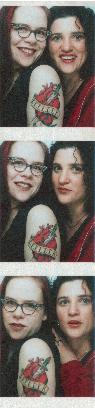
    Finally we went to the photobooth at Newberry’s. Our kids fed quarters to the bubble gum machine while we sat on the swiveling stool and zapped through a couple of bucks. We had decent photos within ten minutes – and in fact, we had at least a dozen to choose from, all of which worked perfectly for our purposes.

    I am working on two books that will come out next year, and even though they are not finished, the issue of author photographs looms large. Particularly since one of my colleagues lives in a different state. At this point I’m partial to the idea of separate photobooth sessions – but maybe we should do something entirely different. What, I do not know. Perhaps we should be illustrated.

  • By the time we finished editing Breeder both of my wrists were thrashed. I literally could not turn the wheel on my Honda, which had a tendency to stop running in the rainy season anyway, and finally had to get rid of the thing.

    Normally the money from the book advance would have gone to cover critical bills since we were a family living on a graduate stipend designed to support a single adult.

    But while I was shuffling papers around Byron went to a conference in Texas and started dancing with these Swedes who offered him a job over the thumping beat of the music. They said he could live wherever and finish his PhD while drawing a salary – a deal that could not in fact have been any better. He accepted and when my book advance turned up I had already paid the overdue utility bills.

    I petted my check for awhile and then set off to find a car with power steering. I located it parked on Hawthorne: a powder blue 1984 Volvo 240 with ski racks, wonky doors, and a dubious title. I haggled the guy down to fifty percent of his asking price and then drove home in the not-very-luxurious new ride with blue cloth seats.

    One day during carpool my daughter slammed her hand in the door, gouging the skin completely off and breaking a finger. This would not have happened with the Honda; the door would have simply bounced open again.

    The cloth seats figure prominently in this story because at some point during a picnic someone left a bag of recycling and garbage in my car without notifying me, and since I lacked a sense of smell the car was putrid before a passenger gasped and pointed out the problem.

    From that point on we fondly referred to the vehicle as Skanky and I drove it with pleased affection until we were packing to move to Seattle. The week before we left I was running errands and turned a corner and the door that broke my daughter’s finger fell out of the frame with a loud clunk..

    The car needed more investment in mechanical work than I originally spent on the vehicle. We debated the veracity of bringing it with us, but didn’t think it would actually survive the trip.

    In the end we left the car parked next to our house, turned over the keys to the friends renting the place, and waved as we drove off in our (new to us) marginally less decrepit 1994 Volvo 240 station wagon.

    Gabriel wrote this week to say that Skanky has suffered what might be the final illness.

    I’m sending good wishes to the intrepid old car and the wildly optimistic people who are trying to get it running again.

  • I have a photograph of myself at age seventeen, snapped on a street corner in a small mountain town. The day was gray. I had a yellow paisley scarf holding my hair away from my face but the wind picked up strands, blowing locks of slippery blonde hair around and forward. In the picture I am looking steadily away toward the mountains. My eyes are fixed on an unknown horizon and my expression is solemn.

    I showed this picture to some friends and many commented that I did not look seventeen, but rather much younger. Someone reflexively used the word beautiful. The photograph is technically proficient.

    I look at the image and remember that day, that month, that year. The photograph shows the gash where my eyelid was split open, but otherwise gives away no secrets. The scar is hard to make out in a black and white print.

    I do not have an impartial perspective. I look at the picture and remember that the scar was actually red and purple, with small flecks of glass working their way up from the depths of a cut meticulously repaired by a plastic surgeon.

    I look at the picture and remember what it felt like to have a fractured cheekbone, to lose my sense of smell and part of my hearing and the ability to track text on a page. I remember the fact that my jaw was dislocated along with most of my ideas. I remember the headaches that turned my world red, the rage and fear that surged through my mind every day. I remember that everything tasted like blood.

    Beautiful? Not then, not ever. I had already survived cancer and learned to keep secrets. The damage to my face turned a confused seventeen year old girl permanently away from any interest in physical beauty. I wanted to hide the shredded nerves and muscles and splintered bones. The horror of the event did not show on my face because I didn’t let anything show on my face.

    The picture sitting on my desk gives away none of this. The picture does not even reveal the fact that my arm was still, seven months after the accident, in a plaster cast stretching from my knuckles to my shoulder. Other photographs over the years occasionally capture a different expression, but for the most part I still have the same solemn face of that young girl.

    I look beyond the people in my immediate surroundings toward a horizon that is never clear. Beautiful? No; damaged, and determined. The truth is that I am not attractive by the standards of a larger society or even of the subculture I am generally aligned with. The reasons go beyond the fact of my scars, because of course some people find the scars interesting.

    Before you rush to tell me otherwise, I want to be very clear. I do not believe in the idea of beauty. I do not know any beautiful people. I have never experienced the transient physical compulsion of a crush. I see everyone the way I see myself, as a complicated array of problems and secrets.

    I wear what I like, eat what I like, go where I like, do what I like. I don’t care one bit what anyone thinks of my appearance, and I frown at compliments. I would never let anyone else determine the perimeter of my desires.

    The only limitations I respect are those related to the fragile state of this body. Although I photograph well, most people find me rather frightening. Nobody has ever dared flirt with me. The people I have dated have all found their way to me by more direct methods. They are compelled less by appearance — because they do not have permission to care about something so superficial — than by the intensity of my beliefs.

    If you can look at a picture of a smashed face and use the word beautiful then you are responding to something other than the features depicted. The only thing clearly conveyed by this picture is the fact that I was staring straight ahead.

    If you can look at me and use that word then what you are really saying is more of a compliment to your own corporeal reality. If you see beauty where it is not present then you are in fact the beautiful one.
  • The Pacific Northwest Inlander offers this article about the child abuse scandal in the Catholic diocese of Spokane: Sins of the Father.

    This story is important for many reasons, not least of which is the fact that many of the people who were victimized are still not talking. The cultural stigma of rape and sexual abuse often silences the people who need the most help.

    When abuse happens in the context of a family or institution the level of denial is extraordinary – people do not want to believe that it can happen. Boys and men are particularly vulnerable because they are not given permission to admit that they were hurt, that they could not defend themselves and their friends.

    One of the men who came forward in Spokane remembers I began to create a world in which I could live alone and let no one else in.

    We need to protect children, and prevent future abuses through systematic structural activism. But we also need to untangle the damage of the past.

    We need to acknowledge that these men are telling the truth. We need to thank them for their brave and honorable choice to come forward. We need to pay attention to the people who are willing to speak out about abuse, and categorically welcome those stories, no matter how difficult it is to listen.

  • This weekend we walked on the beach at Alki, just before sunset, during low tide. It seemed like all color had been washed away, leaving only the gray of the water and sky and sand. The Olympics seemed to float, the foothills obscured by fog, and downtown refused to sparkle. I watched the ferries go back and forth and decided that I know too many secrets.

  • Yesterday we drove to Olympia to have breakfast with Stella and Al.

    We headed home early because the roads were icy, with entire sections of I-5 between Fort Lewis and Lacey quite slippery and frightening. Or rather, I was scared. Byron learned to drive in Colorado. He listened to his old warped cassette tapes and hummed happily. The rest of us went for defensive sleeping.

    Snow is such a rare experience in these parts I can remember no more than a dozen storms. I’m excited that there may be more snow tonight.

    Back at home the children sculpted a snow kitten and named it Skid Bladnur.