Year: 2005

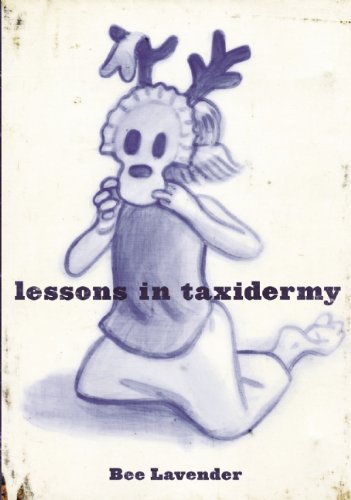
  • I was away for the weekend and came home to find a box of books waiting. The cover, courtesy of Gabriel, is gorgeous. Most writers don’t have the chance to work with publishers who are open to collaboration on book design; I feel extraordinarily lucky sitting here with the finished book in my hand.

    Apparently you can now order it from a site devoted to taxidermy hobby books. I hope that the people who pick it up expecting something in the way of tips on skinning and stretching aren’t too disappointed.

    The title is not ironic, but it may be a bit misleading for certain audiences.

  • Several people have asked what my next project is. When I shrug and say dunnothey narrow their eyes in disbelief.

    But it is true. I think that I should be able to just buckle down and do something new. In the past, nothing could have deterred me from at least conceiving an idea, even if only to discard it later.

    Now, for whatever reason, I feel like my brain is empty. I keep trying to start a much-delayed essay about the experience of moving to a new country but the sentences do not form.

    Instead, I have continued to read, tearing through novels faster than I can replenish the supply and rummaging through our dusty stacks when I need a new fix. I can read three hundred pages a day without much trouble, and twice that on days without parties and excursions.

    It is such a terrific feeling to dissolve into a fictional world. Some of the books I’ve read aren’t very good but others are so amazing it is almost painful to put them down.

  • Text messaging is genius. I can communicate with people via the telephone, without actually talking!

    Yesterday Byron sent a message reading I’m in Paris…

    I replied I’m at Tesco…

  • Mother’s Day is mostly a work thing for me. I have to dig up the obligatory feature article that expounds on the fact that the holiday was originally conceived as a protest for peace. I also have to field lots of interview questions. The day happens earlier in the UK (and apparently has no historic connection with the US version), but Mamaphonic hasn’t been released here yet.

    For the first time in several years, the day was really my own.

    Too bad half the family is still stateside.

    But my daughter and I had an excellent weekend. Her school trip to France was cancelled so we took the opportunity to go to London to get her fringe trimmed, go shopping, and eat a noodle dinner. We even got evacuated from a tube station! It was quite exciting.

    This morning she made me a Dutch Baby for breakfast. Later we went down to the river and, after talking to tourists about my solar panel, had great fun just sitting around reading books.

    Now we’re sitting here listening to Portugese translations of David Bowie songs. I’m going to make pizza and salad for dinner, and then we have some movies to watch.

    Happy Mothering Sunday!

  • I tried something new this morning: cycling in the snow.

    Can’t say that I recommend it.

    My glasses were coated with fat wet snowflakes, my hair and wool coat were soaked, and my back wheel kept sliding sideways. I only made it to the end of the block before I decided to give up and go back to the boat.

    Perhaps I will venture forth on foot. Though I don’t own boots.

  • The new scar on my face has settled into a thin long streak of red, mostly covered by layers of sunblock and makeup. It is currently in that itchy phase of healing that I have always loathed. Pain never bothers me. This prickly throbbing is maddening.

    The doctor said that the scar would fold into my laugh line; it would be more accurate to say that it created one. Byron claims he can’t see it but platitudes are part of the job description of spouse.

    The fourteen year old is a much better resource. I asked Does the scar make me look like I’ve aged years?

    She squinted at me and replied Only on half of your face.

    At least I find the whole thing amusing. It would be terrible if I actually cared about my appearance.

  • In high school most classes were seated alphabetically. Because we were both in the vocational arts track and our surnames started with the same letter, this meant that James and I spent most of our days together in the late eighties.

    Even when I refused to talk to him over some minor transgression, there we sat, furiously not talking. I refused to acknowledge his existence for an entire year after the accident; he was just the ghost at my left elbow. I worked in the photography lab with my injured arm held above my head, staring straight through James if he ever offered to help.

    When we get along everything is brilliant; when we disagree it can be dreadful. Since 1986 it has been rather like having a sibling. We look after each other and bicker and hold communal memories. We are more than friends. James is a member of my family.

    But even though he was present for more than half of the stories in the new book, either as a witness to the action or the salvage operation, he does not appear as a named character. I find this very strange; but the book is about danger, and James represents something else.

    When I turned in the manuscript I wrote to apologize for the exclusion. I did not mean to write him out of the stories; he just didn’t fit in the schematic, and the book was never intended to be a traditional memoir.

    James replied:

    . . .i am in all your stories. but then i am not. right? even when i was involved, my role was to make sense of things. even if that sense was naive or stupid or simplisitic or even wrong. i was somehow innocent of the drama. even if my thoughts/ideas/saying complicated the drama. i somehow remain apart.

  • George Orwell once noted that Writing a book is a horrible, exhausting struggle, like a long bout of some painful illness.

    The book did not feel completely finished until the manuscript went to the printer. Up until that moment there was still a chance that something might go wrong, or bits would need to be changed, and in fact there was a last-minute edit that was crucial.

    Now it is absolutely true: the project is done. Tension that has existed, in variable doses of grim determination, for nearly five years – is finished. I didn’t know what I would think; completing such a long piece of work could have rendered me anxious and slightly paranoid. But I don’t have any thoughts about the thing. I just feel limp and ragged, like surfacing after a bout of food poisoning.

    Of course the start of that Orwell quote is: All writers are vain, selfish and lazy, and at the very bottom of their motives there lies a mystery.

    Looking over the galleys, I really do not know why I wrote the book. I’m not being disingenuous when I say it just sort of. . . happened.

  • By the time I finished writing I was too tired to bother with the author photo. Even thinking about it made me feel itchy and unhappy. In the end I found the publicity shots for Breeder, some random photobooth pictures, and twenty or so photographs I’ve snapped myself with the digital camera.

    I had a hunch that it was best to make the decision by committee; my own inclination is always to remain invisible. The family made the first cut, then I sent the remainder to James for his professional opinion. He picked an image I took sitting on the side of the bathtub back in Seattle, because he said it makes me look like an extraterrestrial mermaid.

    I emailed Gabriel to check the decision and he replied It looks like you, almost. And it is one of your questioning gazes, almost. In other words it is probably perfect for the book as it looks good without being alienating or quite giving away what you actually look like thereby providing a certain amount of anonymity. Of course, I could be wrong.

    Essentially, they are both saying that the image is an improvement on reality, which is true. The point of this particular photograph is to appear not scary. 

    In real life I am  awkward, unkempt, with a facial expression that discourages idle chit-chat. It is fascinating that photographs can tell a different story.

  • For the past few years I’ve been working on a series of stories about danger. The collection is now done, and will be published in April as Lessons in Taxidermy.

  • One day last week I had a brief respite from deadlines and took a bit of time to tidy the boat. I washed all of my dirty teacups, organized the bookshelves, mucked out the stove, and sorted all the tools Byron leaves strewn about the engine room.

    Then I built a fire and sat down to read a book of oral histories about the Pacific Northwest. When I locked the boat down to go to town everything was in order. Hours later as I cycled toward the river I was smug with the conviction that another brilliant afternoon would unfurl.

    It is never good to be smug.

    As I unlocked the door I could hear an ominous buzzing sound. I jumped down into the cabin and saw with horror that the kitchen was flooded, water pooled across the counter and stove. The noise was the water pump; it only sounds like that when the storage tank is empty. I grabbed a spanner and rushed to the back of the boat, pried up one of the floorboards, and stared down at three inches of standing water… where none belonged.

    Of course my mobile phone was down to the last fifty pence worth of time, so when I called Byron to ask for assistance he thought I said that she was taking on water from the river. He came rushing across the city thinking the boat was scuppered.

    When we both calmed down the problem seemed fairly standard. We poked around and tried to get the available pumps to suck out the water, with no luck. Byron went off to the old-fashioned hardware store to acquire tools and gadgets while I mopped up the kitchen. He came back with a pump powered by an electric drill. Genius! Except he did not buy a cordless drill, and the mains on the boat can’t handle heavy appliances.

    Over the course of the next few days we tried various fixes with no luck. Back home this would not have happened; we lived in a community. Regardless of the problem, there was always someone to call, someone to help, or someone who needed help. Staring down at the murky water under the floorboards, I missed my friends more than ever.

    But then I remembered that I wasn’t alone on the river.

    I haven’t met most of the other narrowboat owners, so it seemed forward to impose, but I put out an email asking for advice. I heard back instantly from someone who offered to talk me through the plumbing repairs.

    Then I thought of the interesting, kind people who tied down my boat when she blew off her moorings. I asked if they had a drill to borrow. They cheerfully offered not only a drill, but also to come along and help us. On the way they stopped to borrow equipment from various boats, and then they proceeded to pump out all the water. We laughed and talked and finished the job faster than I could have imagined.

    There was still some water that couldn’t be pumped, and it took the better part of a day to get it out, lying flat on my belly with an arm contorted to reach the puddles with a sponge. By the end I was covered in rust, dust, and small cuts. But the boat is dry.

  • Yesterday I had a wild craving for fresh tortillas with beans and rice.

    In Seattle I would have driven down south to assuage my desire in a restaurant where the cook always chided us for not letting the kids drink soda.

    In Portland there were at least five good burrito shops in the neighborhood. But as far as I can tell, there are no good tortillas in England. Or at least not in Cambridge; I should not rush to judge an entire country based on the comestibles available in one university town.

    Most of the time I think that nostalgia is an aberration better squelched than tended. Particularly when the emotion is attached to something completely out of reach. As a general rule I do not even remember what I have lost.

    But tortillas are a different matter. Somewhere in my wicked youth I was lucky enough to know a woman who taught me how to make them. She made a big batch every week and while I dawdled around the kitchen she showed me how.

    Tortillas will forever be associated with a kitchen that looked out over a forest, pressing dough between cold fingers, learning the rules of a family I did not claim, choosing a future that would allow no room for old friends and places.

    Last night I pulled out a big mixing bowl, measured the masa, heated a pan, and started to cook.