Out with the East London Massive – and look who received the best gift ever:
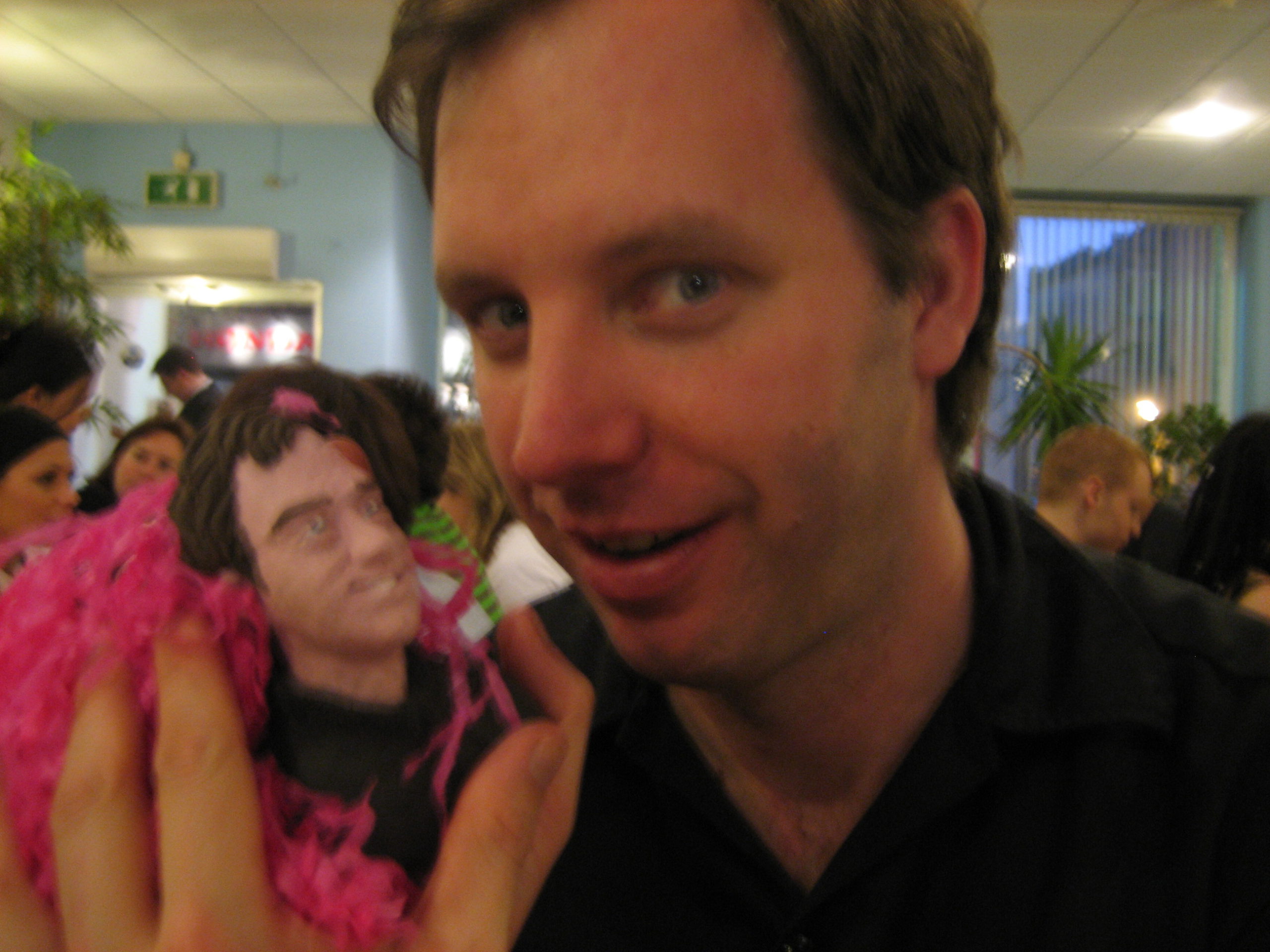



Out with the East London Massive – and look who received the best gift ever:
There are two new things that have vastly improved the experience of life in Cambridge.
First, a fruit and veg stall in the market square is selling fresh carrot juice every single day!
Second, a theoretically Mexican restaurant has opened on Regent Street – and while not good, it is better than anything in London.
We expats exchange the information in hushed and reverent tones.
This morning I stared at my feet for twenty minutes, baffled by the fact that my toe is a solid yellow and brown bruise. Several hours later I remembered Oh yeah…. it is broken….
Today was officially the start of sunblock season; I’ll be slightly sticky from now until next autumn!
As I cycled across Jesus Green in my standard summer costume of black, black, and more black some gutterpunks shouted Oh, my, goth! at me and I laughed and laughed.
Except, are they called gutterpunks in this country?
On her last night in town Marisa and I went on a long walk out to Fen Ditton, traversing muddy fields and listening to birds sing. We stood at the river’s edge and watched the light fade from the sky, the colors reflecting on the calm water.
Back in town we stopped at a pub to toast each other with Guinness and observe the population in their natural habitat. We’re both given to quizzical behavior of this kind; it is good to hang out with someone who has an equal need for silent assessment.
At some point when we were not analyzing the group dynamics at the table next to us Marisa informed me that I exercise a high degree of femme privilege.
I objected But I’m a thug!
She answered Yeah, but you get away with a lot because of the hair, lipstick, and skirt!
This was interesting in part because she has only known me in my current incarnation. For most of my twenties I wore military surplus trousers, tattered tshirts, and a black hoodie. I dragged my gear around in a bike bag, and although I didn’t wear patches professing love of gardens, I definitely dwelled within the North Portland bike punk aesthetic.
Before that I had the complete kit of a bureaucrat, including beige skirts, blazers, and ugly shoes. My hair was cut in a very proper bob and I even had normal spectacles (for the first and only time since my mother selected my first pair at age ten).
During my teens and even my childhood I was of course a fashion oddball, with a clear and inappropriate tendency to wear mismatched and brightly colored vintage clothing layered on top of longjohns despite my mother’s best efforts to make me look decent.
Throughout these switches I’ve never been more than vaguely aware of how my clothing is perceived by others. It is true that I deliberately wear costumes, but only for my own idiosyncratic reasons – not to convey some kind of message about my identity.
I’m not very good at the whole girl thing. My hair is an uncontrollable mess, my clothes are generally in a state of profound disarray, my nails are clipped to nonexistence. I’m wearing the lipstick Sarah-Jane picked out for me seven years ago because I am too frightened of make-up counter ladies to seek out a new color.
The rest of the stuff I smack on is just several layers of sunblock to ward off new tumors, even if it appears that I’m trying to look like a china doll. I’ll concede that I do paint my eyes… but I make them look bruised! Mark Mitchell helpfully points out that my shoes are too frumpy for the average nun (and that I have thick ankles; it is true, I’m a peasant).
If I’m exercising what Marisa refers to as femme privilege I do not see exactly how that manifests, since in all of my travels someone has offered to carry my suitcase up the tube stairs exactly once.
The assorted chivalries accorded ladies never come in my direction. I’m admittedly oblivious, but very few people would even dare talk to me.
When I pointed that fact out to her she said Yeah, exactly!
The UK version of the book includes a reading group guide. This is of course odd for me, and hilarious for my friends. Marisa gleefully read out a question that starts with a quote from the chapter called Make-believe:
‘It would be easier not to care about anyone.’ Do you think that Bee ever thinks this, or do the benefits always outweigh the negatives for her?
I winced and asked Yeah, so what is the answer?
Marisa said You think that all the time!
She is correct.
We were up most of the night talking and I walked her to the bus at five this morning. Our friendship is based on the routines of daily life: running errands, making food, hanging out with the children, wandering in and out of each others houses. We pick it back up again when we are together but there is never enough time.
The fact that I care means that saying goodbye hurts.
Mark is leaving the Bus Stop and this is excessively sad. Tonight is his last turn behind the bar – if you are local stop by, and tip well!
A woman’s life is hard
Union Maid, as performed by the Amalgamated Everlasting Union Chorus Local 824 (we never did sing the Guthrie version)
Even with a Union Card
She’s got to stand on her own two feet
And not be a servant to the male elite!
We’ve got to take a stand
Keep working hand in hand
Cause there’s a job thats gotta be done
And a fight that must be won!
Marisa is here ostensibly to look after my son while I dash around doing press stuff, but she also says that she is familiar with the concept of emotional support.
That is something I clearly need, as the absolute oddity of the week has nullified most of my practical skills. The other night I found myself in the vegetable aisle at the grocery store muttering What do I know how to cook? What do I even eat??!
My dear friend took over and sorted out dinner, and my kids shouted with joy It smells like Portland!
In the evenings we’ve been working a lot – I continue to toil away on secret new projects, the boy has schoolwork, Marisa is putting together a book about Rock Camp.
The fact that we each sit here on dueling shiny white Mac laptops is in fact surreal, given how our friendship started, as members of the Chorus.
We used to sing together every week, lovely friends gathered in the living room of my house, M trying to keep the raggedy group in order, Stevie throwing pop-its into the circle when she was bored, my daughter singing faster than anyone could keep up with.
There were performances around town and on the road, most notably at the first Ladyfest, when Stevie and Erin Scarum accepted a challenge to wrestle in beauty bark right before we went on stage and then spent several hours wailingI have splinters in my ass!
I asked Marisa to guess how old my daughter was when she did the solo that night and she reckoned twelve or thirteen.
No; she was nine, still just a little kid, a fact that becomes more amazing as the years pass.
Rallies, zine release parties, movie premieres, bookstore events, a Mudwrestling Hoedown, everyone crowded into my basement raiding the costume collection – I do sincerely miss the good times with those friends.
I refused to accept a Chorus name since I’ve been burdened with a nickname since birth but that just meant they had to torment me in different ways, mostly by chanting things like Be aggressive! Bee is aggressive! while I tapped my foot and rolled my eyes.
Everything has changed so much since then, in every possible way; I don’t even have a wardrobe any longer, let alone an eight-hundred square foot magical thing-breeding basement full of elaborate costumes for every occasion. Not to mention the way that life has me spinning wildly away from everything I’ve ever known.
But I still have friends, and I can still sing, even if it only happens when Stevie or Marisa visit. We trawl through the record collection and something familiar comes on and my daughter and a friend set off on a song.
I don’t even sing when I’m alone but when they are here I follow their voices, and remember, and it is profoundly wonderful.
Today is my great-aunt Rosemary’s funeral.
Rosemary and her daughter always wore their hair in matching towering black bouffant styles and served coffee and cookies to guests. She was gentle, sweet, always mildly surprised by the antics of those around her. Rosemary loved her husband, daughter, and house, and I was happy to visit when I was in town.
I feel sad for my cousin, who has buried a partner and two parents in a few short years. I feel sad for my surviving great-aunt, the last remaining sibling of a raucous crew. I feel sad that my family has nearly vanished.
There is no way I will be able to make it home for the wake. This is the first time I will be separated from my people as they drink to the dead.
The last time I saw Rosemary she had given up whiskey in favor of champagne. Tonight I’ll raise a glass in her honor.
One night at an Irish pub in France (not my choice of venue) I was telling Josh fractured skull stories. The rest of the table stared in consternation but the two of us laughed and laughed.
When I finished talking he grabbed my head and started rummaging around, looking for evidence. I patiently pointed out the permanent stain on my forehead, then guided his fingers to the bit at the back, hidden by my tangled hair.
I did not let him palpitate the orbital fracture under my right eye; that would have been just a shade too familiar.
It was only hours later that I realized I let someone touch my head. Without noticing, or caring, or feeling anything except the bubbling hilarity of the encounter.
Until recently I would have jerked away reflexively before the other person had a chance to so much as reach out a hand.
My aversion to touch was never theoretical; it was a residual side-effect of three separate head injuries (and more than my share of fights) that left me dealing with what can be summed up as a really bad headache for more than half of my life.
If you’ve been whacked upside the head often enough you learn to keep your skull clear of danger. The brain does not differentiate between pavement, doorframe, hand of a friend – any solid object represents risk. Simple.
The first few times I travelled to Europe this caused social problems, because I flinched away from the cheek kissing custom. I was, I am sure, spectacularly rude – particularly when Gabriel took me to visit his friends in Rome.
In fact, up until I met Iain and Xtina last year, I would have done almost anything to avoid that introductory moment, no matter how much I liked or trusted a person. I flinched the first few times they greeted me in the standard, friendly, appropriate way – and then I got over it.
How? There is no special trick.
Three years ago I visited Barcelona and experienced breathtaking views, and near-paralyzing fear, following the children as they dashed up and down the stairwells of the Sagrada Familia.
We took a gondola up a mountain to see a fortress, and I suffered from white-hot anxiety so severe I could not open my eyes – and very nearly walked back down the mountain rather than face the return ride.
That, however, is not consistent with my beliefs. I got back on the gondola and kept my eyes open.
Last autumn I rode another gondola up a mountain in Trento, Italy, leaning against the glass and staring down in wonder at the scene below – without any trace of fear.
A few weeks ago I stood at the top of St. Paul’s in London, unconcerned with either the climb up or the imminent return to the cathedral floor.
The way to face your fears is simple: face them. And when you can’t? When it hurts, when everything feels awful and impossible and you want to give up? When you fail? Just keep going. Stand up. Walk out. Stare it down.
If you can’t do any of those things? Just stay alive.
Everything will change, if you wait long enough.
Given that three-quarters of Lessons in Taxidermy was written in response to questions posed by Marisa, it is not surprising that our conversations over the last few days have inclined toward the intense.
Discussions about life, love, and work spill across breakfast, lunch, and dinner, concluding late every night when I send her off to her bed with a hot water bottle. She has an uncanny ability not only to sense what is on my mind, but also to sum up complicated issues I’ve been pondering for months.
Where writing is concerned we almost mirror each other – but she is always more succinct in describing the process.
Mostly, though, we laugh. We also read newspapers and books, lounge around, check email, listen to music, play with the boy, go for walks, work.
Normally when someone visits I feel that I haven’t done enough as a host. But Marisa isn’t a guest: she is family.
The other night my daughter was chattering with us about thirty-seven different topics at once and at some point said I have a blog for my internet junk and a paper journal for my private thoughts.
I replied I don’t put my private thoughts anywhere.
Her response was instant: Your private thoughts are boring!
Back in Portland Marisa was an important part of my daily life. We lived in the same neighborhood, shared meals all the time, and performed together; I went on tour with her band, and we’ve done solo shows.
If someone in the family needed help she was always dependably present – she even typed Byron’s thesis when his arms were injured. She is the designated executor of my will and the person who will decide where the children live if they are deprived of their parents.
Beyond the pragmatic details there is also emotion. My daughter points out, correctly, that Marisa is the only person who makes me literally jump with joy. She is beloved by the entire family and has an intense and extraordinary friendship with my son.
I do not regret moving away, but I miss my friends. The fact that Marisa flew all the way across the world to help me this week is beyond amazing. I am honored to know her and have this time together.
Yesterday we went to Ely to see the Cathedral and climbed the Octagon Tower to look at the view across the Fens. We listened to a classical orchestra rehearsing for a concert in the nave. I showed her Oliver Cromwell’s house, and the place I moor when I take the boat out, and we walked through muddy fields watching rabbits hop in the distance.
We laughed and wandered. People change – she arrived with a mobile phone and laptop, something I could never have conceived of back in Chorus days, and shocked me by using the words “bluetooth” and “youtube” correctly. I am almost not recognizable as the person she met at age twenty-eight. But the friendship is as strong as ever.
Sitting at the Cutter Inn, legs splattered with mud, we watched the sun go down and the full moon rise over the River Great Ouse, talking about the past and the future.
Later, back home again, we walked out to the Jesus Green to see the lunar eclipse. My son ran in circles around us, spinning and laughing with delight.
Marisa said Wait – I’m in Cambridge looking at the dark side of the moon – I’m totally having a classic rock moment!
This week I’ve been waking before the birds to ponder assorted tricky questions. Early morning has typically been the end of my day, not the start, but the adjustment happened naturally and mysteriously. I’m enjoying the change even if it might be temporary.
Seeing something routine in a different way is fascinating.
Right now I’m bouncing around in a state of bliss because Marisa just called from the airport – she will be here in a few hours!
I love her so much even if I never use the word often enough.