Year: 2007

  • The current edition of Publishing News contains a full-page interview with me that describes the book as an unflinching, beautifully written memoir of a childhood lost to illness.

    It goes on to say that in person Lavender… talks about trauma after trauma in a disconcertingly cheerful way, often punctuating her sentences with a trilling, girlish laughter. Indeed, it is hard to reconcile the happy, healthy person in front of you with the life she describes in her book.

    Fair enough.

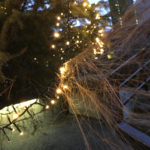
    This morning James was sorting through his archives and found a photograph he took when we lived in a narrow rickety yellow house on the edge of a forest.

    My misplaced husband sent money, James cooked the meals, Byron gave me rides to the hospital. We three adults living in the house took turns watching my small daughter. I was recovering from the last miserable round of radioactive isotopes, and I was so sad.

    Though I never mentioned it to anyone. Why would that be interesting?

  • Three of my friends are pregnant again, approximately eighteen years (mathematically half a lifetime, culturally an entire generation) after giving birth for the first time.

    I’m thrilled for them – and I can’t wait to see and hold the infants they produce. Babies are remarkable small people. The three families are very different in terms of construction, but each will offer an amazing life to the children they produce.

    The choice to have a child at any age is a serious proposition, requiring an amount of work that can never be anticipated. I respect and admire anyone who takes the challenge, particularly those who know exactly what it means.

    When I look at my own children I am thankful that the years of primal need are over, that they are big and strong and independent. There will be no more babies in my life unless I become a grandparent.

    I’m in awe of the fact that my friends are so hopeful and have so much love to offer. I send them congratulations and best wishes.

  • My left leg has finally healed sufficiently that I can go on my daily bicycle ride; my right foot has not, but I can push off from the heel and that is good enough.

    Riding in East Anglia is often accompanied by a crashing wind coming straight off the Fens. The best part is when the wind is at your back, relentlessly driving you across the flat fields, nearly knocking the bike off the path. It reminds me of being a kid on the ferry to Canada and jumping up on deck, letting the air carry me aloft.

    But the wind can only be at your back in one direction; riding home again it is also relentless, each stroke of the pedal moving the bike only incrementally forward. I know this, know that I’ll also have to ride with one hand holding down my skirt, but I would still choose the difficult ride if that is what is required to experience the other.

    After my ride I walked out to Lammas Land and the folly, listening to an album I’ve never heard before, the wind whipping my hair up and around my face until I could no longer see anything.

  • The other night at a party littered with international academics Jean attempted to quiz people about how old they were when they lost their virginity. I was the only person to answer willingly. Jean gave out his stats (if you want to know, ask him). Byron and Rachel had to be prompted but they disclosed.

    Everyone else just stared at us. Two refused emphatically, then started to debate the definition of virginity, and what constitutes sex.

    When you associate with people who live on a spectrum that starts with theologically imposed chastity and arranged marriages on one end, and profound decadent hedonism on the other, these conversations can sometimes lurch in directions one does not anticipate.

    At some point one straight white man said You wait for the right person your entire life-

    Only to be interrupted by another straight white man who retorted But you have to do something while waiting!

    I blinked and took notes, but did not join the discussion as I cannot relate to the concept of the right person as some kind of ideal that can be sought, or obtained.

    Last year in Seattle Jeffrey told me about his theory that if you ask people for their virginity story and they tell you immediately, it means you are good friends. If they decline or lie, he said” talk about the weather while taking tiny steps away from them until you can no longer hear them speak.

    This model presumably works in the context of the west coast indie-alternative scene in which he dwells. But of course when he tried it on me my mouth dropped open in shock and I refused to answer. Though I was apparently exempt from his schematic since we’re still good friends.

    Later I sent a text with an abbreviated version of my very sweet story involving someone I loved with all my heart, who later succumbed to injury and violence. What happened between us, whether bad or good, was true and I do not regret any of it.

    Life is a complicated adventure.

  • I spent the day exchanging email with people to promote the book, scrambling around putting things in order, and somehow also managing to conduct an important secret conversation.

    During the course of a discussion with my agent she asked about my weekend and I filled her in.

    I signed off with My life is sometimes quite peculiar.

    She replied Yes, I’d noticed that!

  • I sleep with my hair knotted up on top of my head but since I’ve taken to brushing it the whole mess slips around and falls apart. Last night it all came streaming down across my face and neck, waking me.

    I swept it back in place and stretched out, blankets pulled up to my chin, listening to the rain hit the boat.

    Outside the crocuses and daffodils are blooming. Spring is here, everything is changing, and that is brilliant.

  • The other evening Rachel grabbed my journal and started to read through the scribbled notes and character sketches. Ten pages in she found a description of a secret plan that might change my life significantly. She borrowed my pen and scrawled NO!! at the bottom.

    Lucky she didn’t read a recent journal that starts with Note to self: do not make stupid mistakes and repeat lessons learned before age twenty-one.

    On her last night in town a crew assembled at Jean’s flat to eat tasty food and drink lots of red wine.

    It was an eclectic bunch of historians, linguists, barristers, mathematicians, immunologists, and artists, born in six different countries and most of us living far from home. There were no English people present until Paul showed up at two with an emergency supply of cigarettes, by which time we were all laughing uproariously.

    Somewhere around three in the morning a fabulous boy turned to me and asked a technical question about (look away now if you are squeamish) fisting; someone else needed to know about female ejaculation and I found myself practically running a disease prevention seminar.

    I never talk about the fact that I have a degree in health education, but lots of people seem to sense it.

    My first job in that field? Teaching sex ed in a juvenile detention facility. When I looked younger than most of the kids in the classes.

    It was nearly dawn when it was time to say goodbye. I offered good traveling wishes to Rachel and we embraced. She exclaimed That was almost like a real hug!

  • When Jean introduces me to people he says things like (imagine this in a posh South African accent, which for the uninitiated sounds like 19th century boarding school British) Her book is about growing up with seven different kinds of cancer!

    I shake my head; he hasn’t read it so this synopsis is quite misleading. Then I patiently explain that it isn’t about cancer at all. The book is about danger.

    Not the danger of growing up with a rare genetic disorder and two kinds of cancer. Not the peril implied by poverty and violence. Not the ramifications of a horrific accident, or any of the other sundry things that happened in my early life.

    The book details all of those experiences, but it is about rejecting that legacy and choosing to take real risks – like falling in love, raising children, finding friends. From my perspective it is more dangerous to care about someone than it is to simply stay alive.

  • Marisa arrives in a few days and she says that she is looking forward to being a stranger.

    That is one beloved feature of life here that has evaporated for me. It took longer than normal but it is now impossible to go anywhere without seeing at least half a dozen people I know, if not more.

    I want to be anonymous again, but the imminent publication of the book will just exacerbate the whole issue.

    Jeffrey will arrive after Marisa leaves and presumably he will join the clamor for a book release party. Though he recently lost his camera, so there will be no damning evidence to post on myspace.

    When I told Byron the camera disappeared he said Let me guess – drunk, at karaoke?

    Yep. Now the world will have to do without photographs of us acting, as Jeffrey says, adorable:

  • My favorite part of the publishing life (aside from writing sentences) is the book tour.

    There was a time when I was too frightened of my own voice to even talk in seminar; it was an excruciating ordeal to give talks or present academic work. I thought that I had a phobia about public speaking.

    But apparently I just disliked talking about policy analysis. This might have something to do with my impatience with people who fail to grasp simple concepts like, oh, the necessity of civil rights laws.

    When I started reading pieces of my books to audiences I was surprised to find that instead of cringing I felt a rush of pleasure. People who met me on the road back then were always puzzled by my demeanor – whether they knew me in real life or via the work they expected the somber and wary person I had always been.

    Instead they found me giddy, laughing, even if I had just read a piece that made the audience cry.

    When I’m interviewed journalists routinely ask if writing Taxidermy was cathartic; the answer is no. I do not believe in the book-as-therapy model. Writing it the first time was painful. Writing it again after the theft was actively destructive. The winter I ran off to Gabriel’s family homestead to work on the manuscript stands out as the lowest point of my entire adult life.

    I finished it, and went through the rather grueling process of getting it published in the states, because I had a political agenda (refer back to early career in disability civil rights implementation).

    Performing, on the other hand, is a tonic. Standing in front of an audience I found that I could say things I would never even whisper to the closest friend.

    Travel for endless weeks telling strangers shocking stories about poverty, violence, and cancer? Fun!

    I like the actual performance; it is brilliant to hear an audience laugh. But I also like traveling. It is no burden at all to be on the road, passing through towns so fast you don’t even know where you are, driving too much, flying too often, skipping from anonymous hotel rooms to borrowed couches, sleep deprivation, odd meals at strange times, meeting scores of new people, visiting old friends.

    One major difference between the U.S. and the U.K. in terms of publishing is the fact that the culture of touring is different here. There are occasional events and lots of festivals – but the stateside model of fifteen readings in seventeen days spanning two coasts with a stopover in the Midwest is not the done thing.

    I feel deprived of a special treat!

  • My agent texted to say that she would be a bit late to meet me. When I replied in my standard positive fashion she wrote back You’re always so amenable. Do you secretly seethe with resentment?!

    The answer is no. If I feel resentful I state my case and move along; seething is not my style.

    We met at the South Kensington tube stop to walk over to the V&A for a fabulous private party with actual celebrities wandering around. It was quite interesting to talk to various other writers and several people who are employed by Orion.

    Two of the folks who worked on my book shook their heads and informed me that I do not look like my publicity photographs. This is true, and generally surprising to people when they meet me for the first time. One of the women said You’re…. blonder… than I expected.

    The museum currently features an exhibit devoted to Kylie Minogue and I wandered around staring at her tiny little costumes. My publicist caught up with me next to a video projection screen and we talked about marketing and promotion bathed in the glow of a pop princess.

    After the V&A party ended Susan took me to a launch for the Cheap Date Guide to Style, and we graciously allowed Byron to join. He has never attended publishing parties before as he was sure they would be dull; he was shocked to observe ravishing hedonism and instantly declared a desire to change careers.

    Back in Cambridge at the weekend I was pleased to hear from Rachel, who told me to buy a lot of wine and meet her at Jean’s flat. I dutifully collected up four bottles thinking it would be funny to offer such an abundance but the place was full of strangers when I arrived so I left most hidden away in my bag.

    This proved to be useful as the party was still rocking long after the respectable people wandered away to bed. The extra bottles contributed to assorted drunken antics, including a group effort to make me dance. I resisted, a sexy girl tried to drag me up off the couch (sensing a trend?), but luckily I had the excuse of the broken toe.

    Rachel grabbed my phone and sent racy text messages to people she hasn’t met, this time without signing her name. After she described one particular revelry Gordon wrote back to query who had been involved.

    I texted I’m pure and innocent!

    He retorted That isn’t an answer!

    To which I replied True, but it is an accurate description!