Year: 2012

  • Alert! You have a rare opportunity to hear me read! One night only in London!

    More information about the show:

    Golden Brothers by STS
    Golden Brothers is the debut novel of musician (The Haggard, Cadallaca), zine writer (Way Down Low, The Gay Hotel, Nightmare Girl) and Queercore activist STS. Eileen Myles says “Golden Brothers is made out of the strange uncommon beauty that fills the empty spaces outside of capitalism. Scenes change swiftly as music. Life and death are moments.

    Fieldguided by Lisa Schonberg
    In this book, entomologist Lisa Schonberg presents her research from summer 2010, through drawings, text, and sound recordings. Lisa is a drummer and played with the bands The Strangers, Kickball, Explode Into Colors, and STLS, among others. Her previous book, The DIY Guide to Drums, is also available.

    Fuck You Seattle by Bee Lavender, from the Madonna & Me anthology
    Bee is a zine publisher and activist from the Pacific Northwest who emigrated to England eight years ago. Her books include the critically acclaimed memoir Lessons in Taxidermy and the anthologies Breeder and Mamaphonic.

    More information about the show: X Marks the Bokship

    Note: STLS is also on tour! Check out the band as they maraud across Europe!

  • How does it feel to have three different and apparently unrelated kinds of cancer? Specifically, cancer that is characterised as “aggressive” and “rare”?

    The summary: I do not feel special.

    Cancer is neither rewarding nor entertaining. Chronic illness is tedious, annoying, objectionable. I have no patience for the attitude that there are moments of illumination; in fact, my experience has demonstrated the opposite.

    I haven’t been to my favourite cafe, pizza takeaway, newsagent, or grocery since the cancer treatment started, because I know and like the people who work in those places. They will look at my face, and ask – what happened? Are you ok? They won’t be able to deal with the answer, and I won’t be able to handle their superficial sympathy or transitive grief.

    I’ve been avoiding all of my friends, ignoring invitations, neglecting social obligations, not because I care about the new scar: no, quite the opposite. I hold my face up to the world, walk where I like, go to work every day, talk to colleagues and strangers without any qualms. My life doesn’t stop because another layer of skin has been stripped away. I have no fear and no hesitation as I wander through the world.

    The only real problem in this whole mess is dealing with the people who love me. Most react in the stereotypical way: they vanish. I understand. Cancer is frightening. I’ve learned that it is easier to walk away first, before I get hurt, before we test the true limits of the friendship. I’ve learned to pretend that I don’t notice, learned to ignore what doesn’t happen, because lack of care is simply an empty space that can be filled.

    And anyway, the people who run away are just scared. The next most common reaction is destructive: whether because vulnerability attracts vindictiveness, or because people are simply thoughtless, I do not know. I have just observed that grievances and grudges accumulated over years come to the surface only when I am recovering from surgery. This is baffling, but so juvenile I react exactly as I did in junior high: I turn up the music really loud.

    There are a few people who are steadfast and true, who stay in touch and listen to my cracked stories, who know that it is okay to laugh. These people are rare and precious, and they are scattered all across the world. Some live nearby, some are far away. I miss them, and I want to be with them now, but I won’t pick up the phone.

    Whatever I have endured or achieved, there is always a cost, and always a loss. I don’t impose on my friends, even when they want to help, even when I want help. There is nothing I could ask for, nothing that they could give.

  • There are very few places in the known universe where a woman with two black eyes and a sliced up forehead can go without risking comment, stares, revulsion.

    This weekend, I found one of those places.

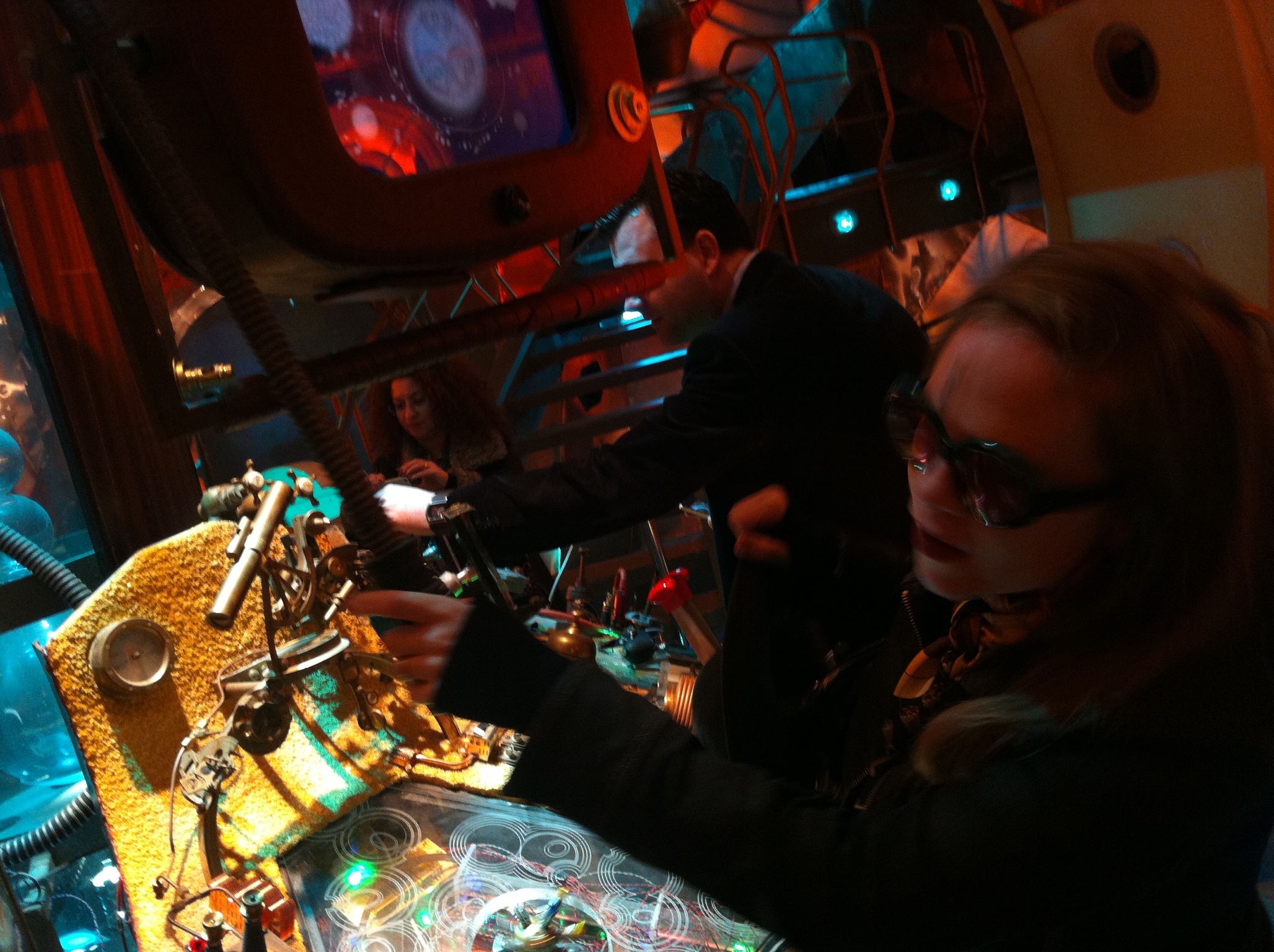
    I’m in Cardiff with my kid for the official Doctor Who Convention, which has been a fantastic adventure nearly beyond belief.

    Every single one of my childhood dreams will be fulfilled. Systematically.

    This morning that included transport to the film set, where I nearly melted with joy as I wandered around the Tardis:

    IMG_1698

  • Today the bandages came off for the first time.

    I stared at myself in the mirror for awhile, then turned to Byron. I said “Normal people would be really upset right now, wouldn’t they?”

    He looked, and sighed, and said “Yes.”

    Lucky I’m not vain, or normal.

    The surgeon was impeccably conservative, taking only the tissue that needed to be removed, and verifying each layer with diagnostic tests. The reconstruction was performed by a world class plastic surgeon, and he feels he achieved an “excellent result.”

    Would you like to know what that looks like?

    It looks like my face has been slashed open. Think duelling wounds, or fending off a knife attack.

    I honestly don’t know or care what other people think of my appearance. I don’t care if you notice the scar, or what you think.

    The only opinion that counts is my own, and this scar is disturbing because I can see it. Looking at it reminds me of things I prefer not to think about. This is simple, unavoidable, and awful.

    Because, like I told the nurse in the recovery room, you can’t argue with cancer.

  • I was officially diagnosed with two different kinds of cancer in 1983. Since then, I’ve never gone more than three years without a biopsy, and subsequently, there is no nervous anticipation attached to the results.

    The lab examines the tissue and confirms what we already know, repeat, ad infinitum.

    Because of my history, the doctors take off a margin of flesh around all the suspected tumours. My ‘biopsies’ always, without exception, remove the entire cancerous lesion. Everything even vaguely suspicious comes off. This means I have some unnecessary scars, but never need follow-up surgery.

    This is so normal to me I don’t even allocate time for the news. Today was no exception – I made plans to spend the day doing fun stuff with my daughter, with a brief stop to have the stitches taken out of my face.

    It was quite surprising then to have the doctor usher me into an office, where he sat on the other side of a huge desk reading the histology report. The lab had found cancer, yes, but not the usual and expected variety. The doctor used some words I did not expect and do not like: malignant, rare, aggressive. He said this is a one in a million sort of tumour. He said “don’t worry.”

    Then he said I would need “proper surgery” – immediately, not in the standard British 3-4 month wait list schedule. Within about three minutes the surgical suite was booked for next Wednesday, along with a plastic surgeon to put my face back together.

    I walked out of the office into a bright, sunny, cursed day. My daughter was expecting lunch and we started to ramble through Marylebone. I explained, briefly, what the doctor said. I told her not to worry. I told myself not to worry.

    I’m baffled, incredulous, and raging. But I’m not worried.

  • Observation: wandering around with a bandaged face is akin to having a superhero skill. I’m invisible! People look at me, and their eyes slide away. . .

    Except, of course, the people who stare, point, and whisper.

    I thought I was used to this sort of thing but I forgot, or refused to believe, what it always feels like. My default setting is to ignore whatever I cannot change and this would fall under that heading, but honestly, the whole thing is tedious.

    I’ve been thinking I should write CANCER across the bandages. Just to, you know, clarify.

  • When the skin cancer specialist heard that the genetic test was negative, he laughed and said “The plot thickens!”

    Then he examined my face, and ordered more biopsies.

    One of the more alarming aspects of my skin cancer is the fact that the tumours are unusual. No general practitioner I’ve ever met could accurately diagnose a lesion, and very few dermatologists have been willing to treat me.

    Looking at my own face, I couldn’t see what the doctor wanted to remove.

    I could only see the scars.

    But that is irrelevant, and the appointment was arranged.

    What does a biopsy feel like? Nothing at all.

    This is the routine: I lay flat on my back, head held still, eyes closed against the light. I listen to the sound of my flesh being gouged away and stitched back together.

    Next, the doctor says some stuff I instantly forget. Then the nurses try to talk to me, offer tissue, a mirror, kindness.

    But I always just want to escape, and inevitably have my feet on the floor before they’ve finished affixing bandages.

    That is how it always works, and precisely what happened today.

    The difference is: I walked outside, accepted a ride in my very own amazing car, stared out the window at a city I love. I went for a walk in my favourite neighbourhood, ate some good food, had some excellent coffee. I walked out of the clinic into the life I chose, the life I made.

    For the rest of the day I avoided mirrors, joked with my family, ignored the bandages on my face.

    Until the end of the evening, when it was necessary to change the dressings, and I saw the raw red jagged stitches crumpling my cheek.

    Then I cried, but not because of the pain. Not because of the new scar, or any of the hundreds of scars marring my body. Not because I’m worried about the results; I already know what the lab will say. I have cancer.

    Instead I cried for the little girl who never knew a single moment free of pain and uncertainty.

    I cried for the little girl who never, ever cried – because she was so busy imagining a new life far away.

  • Today was the big day, the culmination of years of dithering and debate. I woke up early, grabbed a cup of coffee, muttered the standard protests, and proceeded to a prestigious and historic hospital widely perceived to be one of the best in the world.

    The doctor performed a perfunctory examination, looking at my palms and knuckles, measuring my head, scribbling notes on paper. Then she folded her hands together, looked mournful, and intoned the results of a DNA test performed to confirm the genetic disorder I was diagnosed with in 1983:

    Negative.

    I stared at the doctor. She stared at me. There was a long pause, then she said “This is quite a mystery.”

    I raised my eyebrows, thinking, no fucking kidding mate.

    The doctors in Cambridge were so exquisitely sure the result would be positive they refused to run the test. The doctors in London only agreed because I hassled them and because testing for symptoms routinely and in perpetuity seems a little, well, wasteful. Not to mention the fact that the tests themselves are harmful to healthy people.

    “Of course,” the doctor continued, “you are still diagnosed. . . symptomatically.”

    Yeah, well, whatever. This is, at best, sleight of hand. If DNA sequencing cannot confirm I have the mutation known to be the cause of the disorder, we actually know less now than we did last week.

    Why? Because I only meet two criteria of the autosomal dominant genetic disorder they tested for. Critically, the diagnosis stamped in my chart does not explain a myriad of other symptoms. It might be the cause of my skin cancer, but it is not the cause of my primary cancer.

    From the perspective of specialists in various fields, it is categorically impossible to have the specific type of cancer I was diagnosed with at age twelve, unless it can be attributed to radiation exposure – and that is something my childhood doctors insist did not happen. The only other viable explanation is a different autosomal dominant genetic disorder. And hey presto! I have three of the criteria for that one!

    But if I’m diagnosed with a single autosomal dominant genetic disorder, the experts say I cannot have two, because it is “statistically improbable.”

    And now the genetic tests say I do not have the genetic disorder I remain diagnosed with.

    What are the odds of that?

    One possible answer to the conundrum is that I have “something else that nobody has a name for yet.” That at least is more rational than “we don’t want to think about it.”

    I am so tired of this I am barely able to sit through the appointments, but I go back, year after dreadful year.

    Why? Because until we find a definitive narrative, I will be forever cursed not just with ambiguity but also with extensive, invasive, exploratory tests. Just in case.

    The logical and appropriate choice would be for the doctors to order a test for the only other known disorder that can cause the primary cancer.

    Like the kids say, DUH.

    The doctors have steadfastly refused to run the second test because, you know, because. They have a hunch? Inkling, suspicion, belief?

    I stared at the doctor. She stared at me.

    She turned around and ordered the new test.
  • Observation: Lisbon has more drug dealers per capita than any place I’ve ever been. Also, boy scouts.

    The dealers are shocking because nobody has ever offered to sell me drugs, let alone six strangers on any given public square.

    The boy scouts? Well, I kind of thought they were extinct. Or at least, elsewhere in the world the older ones refrain from going out in public with the hats on.

    I’m here to celebrate Valentine’s Day, and on that subject: how peculiar and amazing is it that I’ve been hanging out with the same fellow for a couple of decades, and we haven’t run out of things to talk about?

    Romance, sunshine, and cream tarts: Lisbon is a wonder. Most particularly in the provision of old rickety trams and funiculars to traverse the steep hills.

    This has been the best trip ever.

  • The surgeon wanted to make a standing date for more super annoying cancer treatments every Friday for the rest of the month.

    I went “Uh. . . no.”

    He was surprised – who turns down such exciting offers?

    I shrugged. “I’ll be out of the country.”

    The plan was even (to my not so secret delight) a direct challenge to the whole notion of cancer, because I jetted away toward that dazzling forbidden treat: sunlight.

    Yes, it is true, I took my fresh skin cancer scars and a cluster of tumours-in-waiting to Portugal, where I have deliberately and provocatively walked around during daylight hours.

    Oh, I’m such a rebel.

    Though of course I kept my tender hide covered with multiple layers of clothing and sunblock and such precautions. Because, you know, that is the “right” thing to do.

    And I always do the “right” thing. Even when it is quite clearly wrong.

  • For the last couple of decades I’ve been under the impression that I possess a tendency toward cyclical depressions, otherwise known as Seasonal Affective Disorder or SAD.

    The proof of this would be a tendency toward winter hibernation, and a sort of poignant despondency around my birthday. Which, if you recall, is also the anniversary of my terminal cancer diagnosis and (forevermore) the usual and expected time for me to trudge back to the specialty clinics for more treatment and evaluation.

    It is true that in the past, I have been in a Very Bad Mood throughout the first six weeks of each new year. Anticipating the catastrophe never made a difference, because there wasn’t anything to do about it. I couldn’t conjure up a solution, just like I can’t hope for a permanent cancer cure.

    Except apparently I could make my life feel a whole lot better: all I needed was enough money.

    I have finally and officially clawed my way out of poverty. Desperation and disorder have vanished, to be replaced by . . . not luxury, not at all. I have something better: stability.

    This was the first year I’ve lived in a truly warm house. I own a new winter coat and gloves. I was able to pick and choose specialists, and make judicious decisions about timing the appointments. I have a car for the post-operative days when it is too difficult to face public transit. I have an extra £35 in my pocket to buy salve that makes the scars feel better. I can order food, or eat in restaurants, when I am too sick to cook.

    Critically, I can do all of this without shorting myself or my children in other ways. I don’t have to choose between utilities and dentistry. I don’t have to ignore one bill to pay another, or engage in bizarre machinations, or worry, or wonder.

    I spent forty years thinking I had SAD when really the diagnosis was My Life Fucking Sucks Disorder.

    The new knowledge is so much more useful, because there is a remedy, and it doesn’t require forbidden sunlight.

    Money might not buy happiness. But it can be used to acquire shelter, food, medicine, and all the little necessities and treats that I never even knew I could wish for.

    I haven’t fully recovered from the recent cancer therapy, but this year I’m not depressed. Instead I feel. . . cautiously optimistic.

    Nowadays my life doesn’t suck – in fact, it is amazing.

  • On the fourth day after treatment I was still raw – literally – and my skin had broken out in a predictable and nasty allergic reaction to the dressings. My back was on fire with that special itch so well known, and loathed, in childhood.

    Unfortunately, this meant that I had to grit my teeth and venture out to an upscale lady store, where they sell premium potions that actually work.

    I wouldn’t like to chat at makeup counters anywhere in the world, but the whole thing is so much worse here in England. I like the standoffish silent customer service prevalent in most stores. I do not understand why the people employed in the beauty industry are required to pretend they care. It is all just very awkward and artificial.

    Which might be the point, but it makes me indignant when people suggest that I wear blusher, change my eyeliner, or buy a new shampoo. Do they think my appearance is an accident? Because, you know, it isn’t. Everything about me is excessively deliberate, verging on obsessive. I would think that is obvious.

    I picked up the tiny yet massively expensive pot of salve and queued at the counter to pay, silently hoping for an efficient check-out. But the (very nice) woman at the till, apparently unable to read my urgent need to be elsewhere, started to rattle off the standard solicitations to join loyalty card schemes, take advantage of multi-buy discounts, etc.

    I politely declined all of the offers, including a chance to partake of a free massage. This of course generated a puzzled delay in the proceedings: who turns down a free massage? The person who has recently had a string of tumours removed from her neck and back, duh. But I couldn’t say that. Talking would not expedite the encounter.

    The (very nice) woman held up my purchase quizzically. “Lots of people have been buying this,” she said. “What is it for?”

    Well, as it says on the packaging, it is healing gel. Designed to treat scars and wounds.

    Flummoxed, I wondered if she really wanted to know, if it would be appropriate to tell? But no, honestly, it would not. I’ve had people ranging from professors to strangers burst into tears upon hearing the word ‘cancer’ issue from my flippant lips.

    Instead I held up my calloused fingers and told a sideways sort of truth. “I’m a writer, and holding the pen all day hurts my hands. This stuff makes them feel better.”

    She turned over the jar in her hand, reading the description. “Does it really work?”

    “Yes, totally. Works a treat.”

    She finally handed over my purchase and receipt and I departed to hide at the library, where nobody talks to me, or anyone, ever.