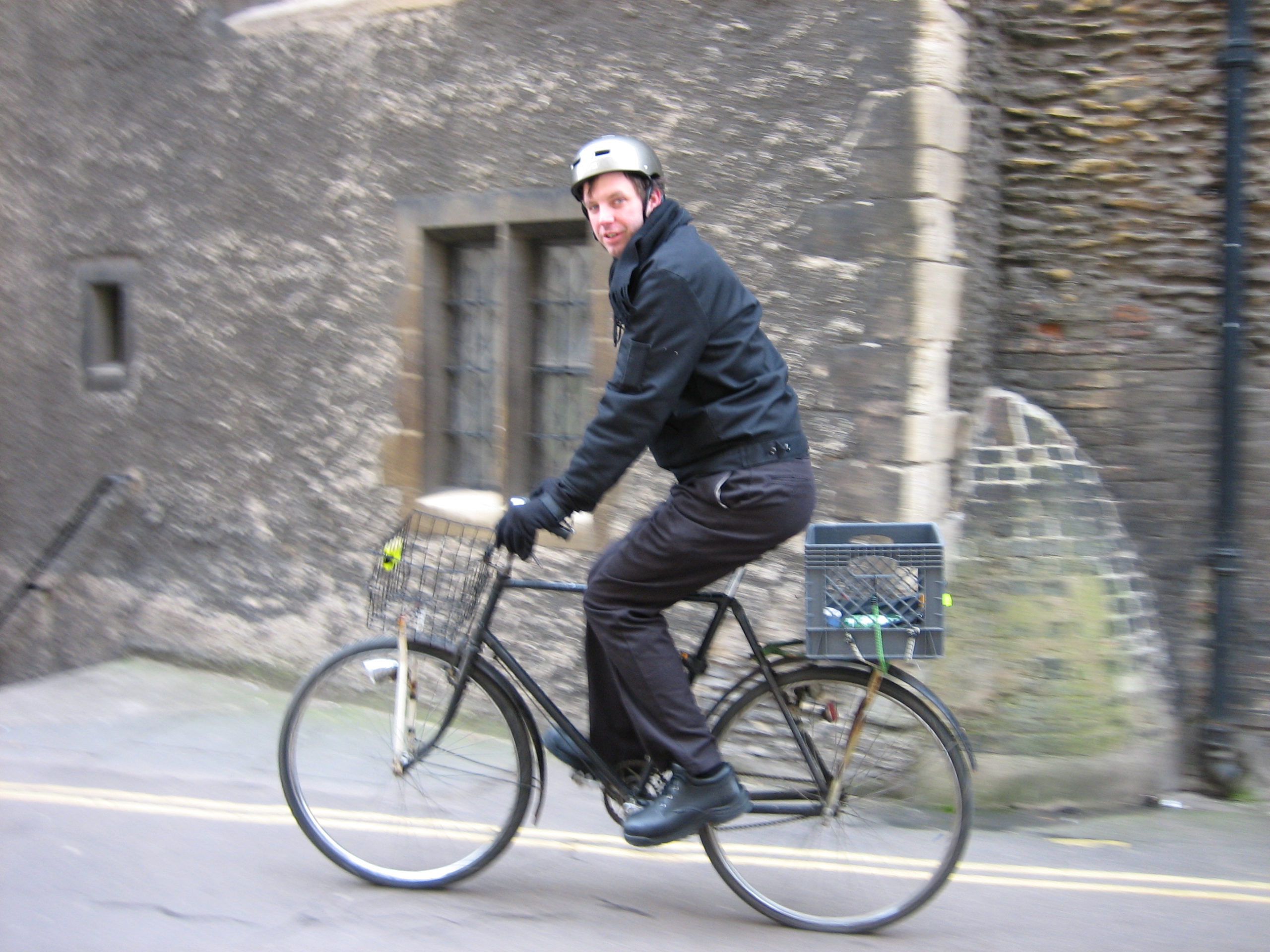
• Byron is the handiest research subject in my attempts to figure out this flirting thing, but he isn’t a very good specimen as he is such a (notorious) natural. Also, and this is critical, he certainly is not more socially evolved than I am. In fact, though he can exert charm effortlessly, he is often completely clueless about the motivations of other people.

    He thinks that all banter is just good fun.

    I have to point out that people are not just being friendly when they invite him up to look at their etchings. He is always surprised to learn that what he thought was innocent flirtatiousness was in fact an explicit offer of sexual favors.

    Even when I tell him ahead of time that it will happen.

    We have divergent abilities to understand our fellow humans; I may not know how to chitchat but I have certainly always noticed when someone tried to seduce me.

    Perhaps the fact that we are both so obsessed with work is the root cause of our mutual clueless-ness.

  • I’ve been reading assorted biographies of dead writers and artists and keep running across the concept of inspiration. I’m not sure that I completely agree that an idea has to come from any old place; things sometimes just happen. But it is true that large swaths of my work take the form of an answer to a question.

    The best example: one sunny day in Portland I stood silently on a sidewalk as two people I knew and liked, both bespectacled girls in braids, had a slap fight in the entry to the health food store on Fremont. I could have stopped the altercation, but I elected to stand aside and remain silent. The episode ended when the manager came out and said Excuse me, ladies, can I help you?

    When I told that story to Inga she was shocked. Why didn’t you do something? 

    I replied that I had no part in their feud. It did not seem my place to interfere.

    But her question made me think about why my instinct was to observe rather than take action. Thinking about the reasons opened up a flood of unwanted memories.

    I grew up in a violent household. I watched my aunts and uncles beating the shit out of each other and their children. I had a baby with someone I met in criminal court. I know what rage tastes like, I know how to protect myself, and I have never been afraid to hit back.

    It would have been easier from any angle to continue to lead a fighting life. I have been conditioned to act out of anger. I love my hometown and, insofar as I was capable of feeling anything after the accident, I loved the hooligans I dated in my youth. But I made a specific and deliberate choice to walk away and create a life that is not contaminated by violence – of any kind.

    From my perspective, it doesn’t matter why people hurt each other. There are always valid perspectives and excuses on both sides. Why did the fight at the health food store start? Who cares? Both of those girls felt that they were right. Besides, it was more than slightly ridiculous to witness some kind of turf war erupting over the bins of organic vegetables.

    The fights I’ve witnessed or conducted were just the same: a strange mixture of bathos and animosity exploding over transgressions that, years later, I do not remember.

    I rejected violence not because I was weak or scared, but rather because I find it easy and banal.

    I responded to Inga’s question with a long email that succinctly outlined what would end up, within the week, as the Fighting essays.

    The fight itself was not inspiring; fights are in fact squalid. But when I had to account for my instinctual reaction I wrote what I feel is the best part of a memoir about danger.

  • The other night I watched Bride and Prejudice, and my primary response is that they should have cast someone else as the lead male character. Darcy is supposed to smolder, not annoy.

    Also, in the book Lydia ran away and had sex with a nefarious soldier, thus ruining her own life and the prospects of her sisters. In the movie the Lydia character surreptitiously sneaks out to ride the London Eye with a fellow we are to believe is disreputable because he lives on a narrowboat.

    This is the second movie I’ve seen recently that equates life on the water with moral turpitude. The other one was bad enough I forget the name but coincidentally cast Jennifer Ehle in the role of a woman who lives on a narrowboat. We are notified that she is bad news with the following additional clues: she is a single mother, she has dreadlocks, and she has a tattoo. She has a posh accent and rich parents but insists on living precariously. And, in a movie about the dating habits of a bohemian London crowd, she is the one who has the worst sex life. Until she hooks up with the slutty bad boy character.

    Historically, the people who made lives on the rivers and canals of this country were disparaged. There were even, for a time, laws that restricted children living with their parents on the boats. This is a classic example of the way an autonomous subculture that fulfills a significant, and dirty, public need is depicted by the cultural elite. For other examples see: coal miners and migrant farmworkers.

    But come on, people. Industry and technology have changed the world.

    We narrowboaters are not the gypsies of the Philip Pullman books, the immoral wastrels of dumb romantic comedies, nor are we any different than any other neighborhood in this town.

    Here in Cambridge, and from what I can tell in Oxford and London too, we’re a representative mix of retired folk, sporty types who like the outdoors, and professionals from various respectable fields.

    That may not be sexy but it is the truth.

  • My body is too fragile for extremes of weather; in the winter, my fingers are so cold I imagine they might snap off. The heat and humidity of summer do not bother me, but sunlight does: it is not an affectation that I wear sunglasses even in the dimmest light.

    My experience of photosensitivity is profound – the world is white and dazzling and painful. If I’m not cautious sunshine can trigger a potentially lethal auto-immune disorder. Even if light did not hurt me, the sun would still be a monumental enemy, given my history of skin cancer.

    Yes, friends, it is true: I am exquisitely sensitive. I should have been born to an era of fainting couches. But I am a rugged peasant and loathe medical authority… so I ignore the injunctions of doctors to stay home and rest.

    One of the main features of my life here in England is daily bicycle rides to distant villages: Waterbeach, Fen Ditton, Coton, Grantchester, pedaling as fast as possible through common land.

    Spring and autumn are the best seasons for these trips, after the cold and before the tourists swarm the town. I ride to feel my legs moving, feel my heart racing; to be in the countryside and hear the birds sing, and find myself surprised every time by the sight of thatch-roofed cottages and old country churches.

  • Recently at an event someone asked me about how I choose what to write in this journal.

    The site started as documentation of moving away from Portland; when I started writing the topic was fairly restricted. Over the years my life has changed, and the journal has evolved, though principally I do regard it as an exploration of leaving home.

    This means that many subjects are simply never addressed. I lead a busy, complicated life, and it is difficult to find enough time to work on the projects I find most absorbing, let alone document the minutiae of my existence.

    People who know me in real life often wonder why they do not appear in my writing, or are merely listed rather than described. The reasons are varied.

    I think that my children deserve privacy (and my son has dictated that I do not write about him). Relationships with various other people, either now or historically, are similarly out of bounds.

    My friends are aware that I am trustworthy and capable of restraint – if anything, I am too inclined to keep secrets. I could never, for instance, write a proper kiss-and-tell, and not just because I used to date criminals. The only confirmation you will ever have about my love life is the fact that I named the correct father on the birth certificates.

    Anything else you hear or believe might be true – or maybe not.

    There are a few people and experiences I feel that I should write about, but resist for fear of stirring up more trouble. One of the most significant is the phenomenon of lost friendship. I know how to talk about my enemies, and about the people who care for me. But what about that other category, the people I love who no longer speak to me?

    I’m not talking about people who drift away, but rather friendships based on true devotion that are abruptly severed. I find it wrenching and painful to even think of two of my favorite people, and have no relative grasp of why they decided to hate me.

    There are facts, which portray all sides in a negative way, and impressions, which make me think that abandonment (specifically my reckless rejection of projects, plans, places) is the legitimate cause of the problem in both cases. But I would have thought the grievances would fade as time passed. I know that I am difficult, stubborn, and contrary. I’ve made no secret of any of my own worst qualities, and accept and apologize for the fact that I have hurt people.

    What I do not understand is why anyone would choke a friendship that is valued, or reject offers of reconciliation that are genuine. Essentially, I do not understand the utility of holding a grudge.

    If I had the choice, I would still know everyone I have befriended in the last six years. I couldn’t say that about any other era of my life, and it is confusing to realize that growing up does not necessarily lead to greater social maturity.

  • Byron took his midlife crisis to Portland today. He was there for work but also drove around the old neighborhood in a moody fashion, reporting back on the changes (major gentrification would be an understatement). He dropped in on Gabriel and later was able to surprise everyone at a party commemorating the fourth anniversary of Stevie’s accident.

    I wish I could have gone! When I think about Portland I feel queasy with longing.

    Despite the fact that one of the other people at the party hates me so intensely she extends the friend ban to my whole family, regardless of age or connection. When Byron turned up at the party, despite her injunction that no Lavender could attend, she had to leave.

    Byron thought it was funny. I find the whole thing peculiar.

  • Learning to recognize the signs of flirtation is rather extraordinary, not because my daily life is much different (though it is – people keep offering unexpected favors), but rather because I can look back at the past and see various incidents in a new way.

    For instance, it occurred to me to wonder why, as an adolescent, I was so frequently shoved into bodies of water. It happened often enough that I always had a change of clothes in my car trunk (along with a case of brake fluid; I was nothing if not prepared).

    I asked Byron if that sort of behavior counted as flirtation, and he shook his head in exasperation before replying in the affirmative. I confirmed the concept by asking Iain (to give the hypothesis a more global test), who also agreed that such things are routine.

    I do not particularly understand why pushing people into a lake, ocean, or hot tub is a sound mating ritual (except insofar as it is a shortcut to nudity) but… whatever.

    Reliable sources tell me that many boys flirt just by moping in my vicinity; that is clearly something that I would never pay attention to as such behavior is not entertaining. Byron would be the prime example, as he mostly just played the guitar and stared at the wall, dreaming that I would be his life partner without mentioning it. For years. But there are many other incidents that do not fit that description.

    One recent encounter: I was wandering around and ran into a friend. He said You look hot today.

    I said replied It is unseasonably warm. 

    He laughed and said That wasn’t what I meant. 

    I stared quizzically and moved along to my next thought, which was likely something along the lines of Is that the church with the William Morris painting in it?

    The argument that my lack of flirtatiousness derives from pure stupidity is growing on me.

    There are too many examples in my stories.

    I asked Byron if the girl who cornered me in the bathroom of the Spar years ago had motives that were not entirely platonic.

    He finds these discussions tedious. He pointed out that the girl was so explicit we were ejected from the bar because of her antics. That encounter was rather routine and the preface of a predictable scandal. Back then intimacy was about autonomy, which makes sense, and revenge, which isn’t very noble.

    Why didn’t I acknowledge the truth? Because she was dating the person I was trying to divorce, and I did not want to question or understand her motives. The easiest solution was pretending it was all a misunderstanding.

    Unfortunately I was a reckless and troubled girl: risk and danger were just about the only things that caught my attention.

    That description is no longer accurate. I have grown so light-hearted I am almost dizzy.

  • Here in the UK there is a huge amount of pressure to decide on a career at age fifteen. The subjects you study, and the test results on your GCSE’s, determine whether you leave school at sixteen or go on to sixth form, and what you are allowed to study if you remain in school.

    Sixth form can loosely be interpreted as the equivalent of a US associate degree, with the attendant choice between vocational and academic work.

    My daughter has experienced this rather intensely since her mock exams predicted A star grades in double English: there has been a push to choose university-prep English as her A level course.

    Numerous tutors and the intake staff at the sixth form college have been quite strident on the point. The fundamental message is that she must choose her future career now. She is in fact a talented (published) writer, with a verbal acuity that will serve her well in life. Her advisors think the path toward a degree in English is already clear.

    They also say she will go to Oxford or Cambridge, whether she likes it or not.

    But the child wants to study art and philosophy.

    When she announced her intent, the tutors quickly started to hector along the lines of don’t choose now! Wait and see! By which they mean, wait until your inevitable top test scores assure you have to do exactly what we already decided on your behalf.

    Art and philosophy are, from a safe middle-class perspective, frivolous.

    I feel mildly conflicted only insofar as it seems that she should have the opportunity to coast around some more. In the states she would have three more years to meander before making big choices.

    Other than that, I think that art school is better than studying English. What can you do with an art degree? It isn’t clear, but within the ambiguity lies the genius.

    My fundamental belief is that people should study what they love, regardless of practical application. When I was sixteen I achieved the highest possible grades and test results in AP literature, composition, and American history.

    Two months later I was kicked out of the honors program and ended my secondary education in voc-tech, where I took a certificate in photography. Since I couldn’t be Ralph Eugene Meatyard I wandered off with my art scholarship and studied…. health education and organizational theory.

    I did a graduate degree in public administration and worked in government. Now I’m a writer, editor, and publisher. Should I have studied English, just because I had a perfect verbal score on the SAT? No. My choices were extremely wise; I gained life experience and perspective that would not have been possible otherwise.

    All of my favorite people are artists, writers, musicians, and mathematicians: people who think and create. None followed a traditional path to arrive at their vocation.

    They all work hard – arguably harder than people who chose the path of least resistance.

    If my kid wants to study art and philosophy, that is her choice to make. She has excellent role models to show her that the choice is risky and rarely leads to financial security.


  • Recently a friend loaned me a copy of a film screened on the BBC awhile back called Decadent Action. The motto that sticks in my mind is featured on a pamphlet the protagonists hand out at a festival: Shop Now, Riot Later.

    The very funny film offers an activist model of consumption, based on the premise that pleasure is a valid goal.

    I’ll never be dissolute enough to qualify as a true libertine but I am in fact a hedonist. I work hard not just for material security but also to acquire new and novel experiences. Travel, food, friendship, trinkets, adventure – no matter what I have, I always want more.

    Even when I was poor, sick, and very young, I had high expectations. I’ll never be the sort of person who accepts mediocrity.

    Decadent desires are not inherently wrong. It is possible to lead an indulgent, defiant, and deeply ethical life.

  • James has been either my best friend or mortal enemy for nearly eighteen years. When I asked him for a suggestion regarding the recent NYC event in which I had to take a “personal risk” I expected him to say something smart and interesting.

    When he said be wrong I was unnerved and angry.

    But I’ve been thinking about his comments: he followed up on the first email with a couple of paragraphs specifically saying that I should tell a story in which I am clearly the antagonist, and definitely doing something destructive.

    There are many stories I could tell to satisfy James. Some are more entertaining than others, but we’ll set aside the torrid ones as I’ve never really cared that much about sexual politics.

    After the accident I asked James if he would have cried over my death. He said no, and although I knew he meant that he simply could not cry about anything, I stopped talking to him for an entire year. He was invisible to me, even though the distorted adolescent world we lived in dictated we sit next to each other all day at school. After we reconciled I had not in any sense forgiven him.

    Over the next eight years, through various moves and scandals, as we baited and cared for each other, I never forgot. I didn’t scheme or plan my revenge, but I did eventually make him cry, standing on the corner of Division and Twentieth in Portland the night before I married Byron.

    But it is unlikely that James wants me to tell his secrets to confess my own wrongdoings.

  • I took my daughter to Amsterdam and it may well be the perfect city: boats and bicycles everywhere!

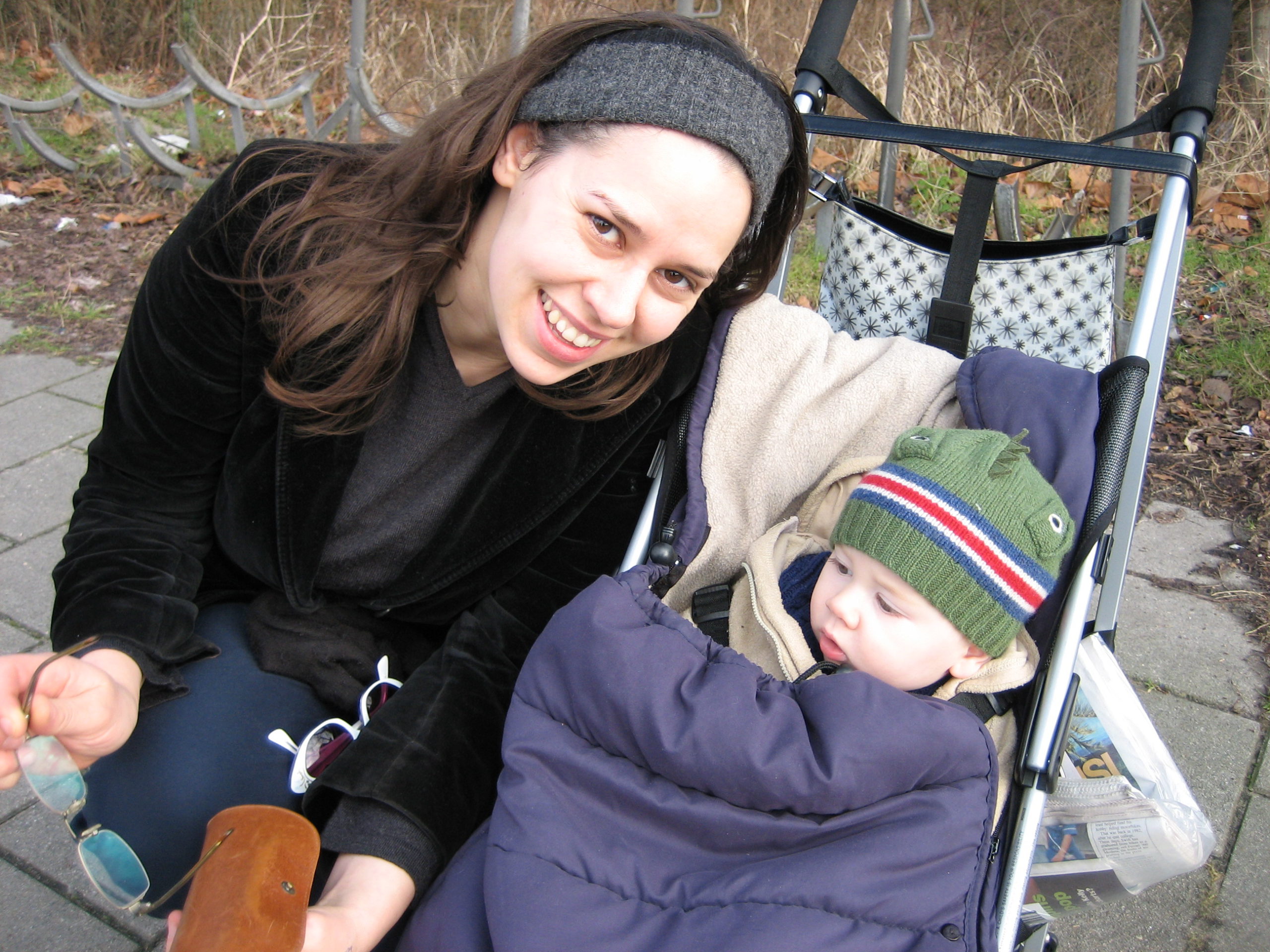
    It was quite lovely catching up with old friends and meeting their new child; Amy Joy and Dishwasher Pete have produced an extremely nice infant:

  • Today the headline on the local paper concerned a machete attack in Parker’s Piece. I was pondering this as we walked across Christ’s Piece (for those of you who do not live in the U.K. think “park”) as my elder child chat chat chatted away.

    Suddenly she gasped and exclaimed Did you see that?

    No, what?

    Some man just got all up in your face and hissed!

    No way!

    Yes way!

    I didn’t see anything of the sort!

    Later some other fellow was apparently trying to make eye contact and wiggling his eyebrows at me.

    I denied any such thing happened, so she reminded me of the time some random person in San Francisco tried to talk to me as I ignored him. Eventually he hollered at my daughter Hey! Tell your mother that she is beautiful!

    Though I didn’t know that part until the child mentioned it hours later. I am immune to such things.

    Happy Valentine’s Day if you are into that sort of thing!