• Last week our collectively muddled travel plans required me to take the younger child to Paddington Station at an extremely early hour to meet his father, who had been in Oxford lecturing and supping at high table and similar fancy things that keep him in that other academic town.

    Luckily, Iain offered to meet me and be my guide to bits of London I would never have found on my own. He is efficient, so the day included stops at Best Shop Ever, Magma, Alfie’s Antiques, Skandium, Daunt’s bookshop and Marylebone High Street, and Selfridges. Then we proceeded to Get Stuffed, a taxidermy store that is fascinating and scary.

    We tried to visit Curious Science but it was closed, then ended the day chatting over tea and coffee at the S&M cafe.

    Such a glorious trip would not go unnoticed by my elder child, who clamored to be taken to the city immediately to buy Moomin paraphernalia and comics.

    I only fended her off for a day before succumbing to the pressure. We decided to stay overnight to maximize the experience and ended up with discount tickets that put us in the front row at the Theatre Royal to see The Producers.

    Iain and Xtina generously joined us on the second day for a tour of the area around Brick Lane. We popped in and out of a series of excellent shops, ate, hung out at a real coffee shop (oh, how I miss Portland sometimes), and checked out the Geffrye Museum.

    It is always better to see a city from the perspective of people who live in it every day. I’m pleased to have such interesting friends.

  • All year long people have asked What are you working on now? and I’ve answered Not much.

    This is true insofar as I throw away ninety-eight percent of what I write (and this is not an exaggeration). I have produced enough material for two long books but didn’t like any of it, so I erased the lot.

    Lately though I have been working very intensely on a top secret project that has required me to research the fashions of the eighties. Specifically, this involved opening my yearbooks.

    Oh, the horror of the decade. The best picture I’ve found so far is an image of the punk kids sitting in a hallway, hunched over their lunch trays, squinting up at the photographer suspiciously. It was not in fact safe to eat in the main lunchroom, and this is I am fairly sure what inspired the attitude and posture of cool that infected my social scene.

    But regardless, the fact is, looking at the photographs, we were simply not in any way radical. The strangest thing about my appearance? I had straight short bobbed hair.

    Not by current standards a transgression. Though back in the day revolutionary.

  • Tonight as I walked to the movie theatre a man approached and said Oh my darling, canna ask you a question?

    I looked him in the eye and said No.

    Then I marched away as he reeled in bafflement and started to shout entreaties.

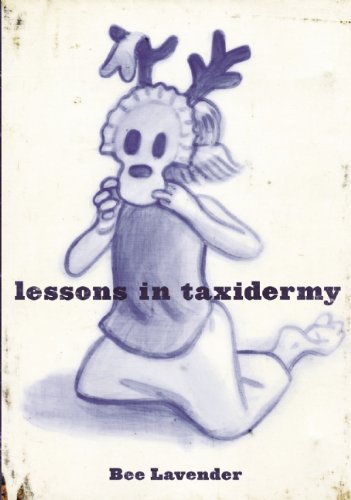
  • In an early version of an essay that was included in Lessons in Taxidermy I stated that nobody had ever flirted with me. Before the book went to press I was challenged on this point.

    It was inconceivable, Byron said after reading the draft. I stubbornly refused to change the sentence until Byron said You are either being stupid or lying.

    If I am not stupid (and nobody has accused me of such except in relation to algebraic equations), and I do not believe that I’m being untruthful, there had to be another explanation. I thought about it and then asked Do you think I flirt?

    Byron replied No, you are the least flirtatious person I’ve ever met. But it doesn’t follow that other people aren’t flirting with you.

    For my age and inclination I’ve had more than my fair share of romantic intrigue. I’ve been mistaken for a prostitute more than once. People have offered sexual favors. I came of age in an overly affectionate west coast subculture. But I never consciously engaged in the superficial verbal and nonverbal activities that I believed to constitute flirting. I did not connect that sort of playfulness with friendship, sexuality, or identity.

    Nor did I want to. I was actually quite proud of the fact that my demeanor repelled casual attention. I liked being tough and unapproachable.

    It isn’t good form to put your faith in one witness so I asked other close friends what they thought. Gabriel reckoned that I am a storyteller, Marisa allowed that I’m charming. Stevie had some interesting points that I failed to write down. James meandered into a scholarly dissection of an unrelated topic.

    They all agreed that I have not historically exerted girlish charms. More significantly, three of the five surveyed also said in exasperation at my obtuseness But I’ve flirted with you, Bee!

    Okay, so the answer is: I’ve been oblivious. But the thing is: I used to have two categories for people. They were either Beloved Companion or Everyone Else.

    When I say that nobody has ever flirted with me, I am not talking about any of the normal interactions I have with my friends. I am specifically saying that strangers do not approach me, unless they need directions.

    It is literally true that, in all of my travels until age thirty-four, nobody ever dared try a stereotypical pickup. How many women do you know who can make that claim? Specifically the sort who wander around wearing red lipstick and inappropriate clothing?

    It is true that I move through the world in a sort of qualified trance state, aware of danger but otherwise ignoring my fellow humans. I never knew that anyone looked at me until I went to Italy with Gabriel, who found it amusing that I didn’t even notice people whistling at me.

    He had a month to patiently indoctrinate me into an aspect of adult life that I had never before experienced. I found it frightening to learn that I was not in fact invisible — and I was thirty years old.

    About a year ago I noticed that strangers were talking to me. Last summer I noticed someone who was definitely not a friend actually daring to flirt, by classic definition! That person went so far as to grasp my hand and stare into my eyes. I was astonished; apparently I have somehow acquired new, and presumably more engaging, mannerisms.

    I tried out the flirting hypothesis on people who have met me only since I left the states, and they all flatly denied that I am not flirtatious; they didn’t even believe the anecdotes I told to illustrate my point.

    It would be a mistake to credit the publication of the book with this change (even though I divested a series of secrets that I had never been able to speak about). It also isn’t about self-esteem; I’ve always been a confident person. The main difference in my life is the fact that I am, suddenly and inexplicably, friendly. It is no longer a burden to meet and talk to people.

    This is somewhat good (I’ll make more friends), moderately bad (I’ll have to learn new etiquette) but mostly neutral. I seem to be living a backwards sort of existence and this is just another example.


  • Lessons in Taxidermy is officially an American Library Association Best Book.

  • I’ve been doing community organizing, both informally and professionally, for more than twenty years. I take the idea of reciprocity quite seriously; the friends I’ve made along the way are people I like, but also people I would work to help.

    It is true that I sometimes feel choked by proximity; I grew up in a small town and have always craved the anonymity of big cities. I want to be able to go grocery shopping, or just walk down the street, without everyone knowing my business.

    I left Portland on purpose because it felt small and parochial, and the insular nature of the town I live in now is not a featured attraction.

    But at the same time I really value my social networks and the vast numbers of people I have had the privilege to meet. Particularly in the publishing world, I have enjoyed tremendous support from writers and editors and booksellers – support that I try to return in substantial ways.

    The thing that bothers me most about both of the current literary scandals is the fact that social capital has been wasted.

    If we don’t look after each other, what exactly is the point?

  • I can’t comment extensively on the recent Fake Memoir controversies because I have not read the books.

    However, as the author of a memoir, I feel inclined to say this: my book is factually accurate. Names and some identifying geographical details were changed, but other than that, I told the truth.

    Also, and this is critical: I did not fabricate, exaggerate, or embellish. In fact, I elected to withhold vast amounts of information. I had a clearly defined narrative agenda, and the facts extraneous to the main story were cast aside.

    Many of the people who appear in the pages of my book wonder why I didn’t examine all aspects of my history. The friends who have heard my lavish and bizarre tales ask why certain stories are not in the manuscript; they want to know if I’ll ever publish the most sensational bits. The answer is a qualified no.

    There are many reasons, none of which are pertinent except my fundamental code of ethical behavior. I’m not interested in exploitation.

    In writing the book I was not trying to win some kind of contest of victimization or debasement.

    If I were playing that game, I could win. I choose not to.

  • The other morning as my daughter prepared to go to a tutoring session I stopped her and said don’t get yourself abducted, okay?

    She laughed, but I was serious, and quickly went through a checklist of how to avoid such an occurrence. She has heard it all before.

    The main point is, of course, to avoid danger when possible. But in the event that she does find herself in a bad situation, it is critical that she knows what to do. In my opinion, this means that she needs permission to fight.

    I’m worried for my daughter, and for other middle-class girls, because I think that some female children are socialized to lose their inherent instinct for self-preservation. My daughter less than most – she has fended off the standard annoying juvenile situations with vicious instinctual grace – but she will never have the indoctrination I received as a working class girl.

    For awhile I thought that we had moved to a town that is inherently more aggressive than others, but over the last few months I’ve realized the danger I sense has more to do with the classic division between town and gown.

    Living in Portland or Seattle or Olympia I knew the rules, and it was clear where I fit. That is no longer true, and a change of costume will not rectify the issue. When I walk across the lock bridge and a man with short hair and a mean dog approaches, there is no chance that we know each other, and every possibility that there will be a negative interaction, usually involving a sexual comment. By this I do not mean the odd random compliment, but rather something that is intended to frighten the recipient.

    This sort of thing simply did not happen back home, no matter how I dressed. My instinct is reflexive: the person who dares try that game with me might imagine they are hard, but when they look me in the eye they usually know they made a poor choice.

    I have access to a tremendous rage that most people inclined to casual harassment are not expecting to encounter. They’ve probably seen it in the eyes of their mother, sister, or girlfriend, but they never want to see it on the face of a stranger. People leave me alone because, honestly, I’m scary.

    I know that lots of strong women get hurt, and I am aware that I may one day find my skills are not sufficient. People are raped and murdered all the time, and there is no magic incantation to fend off the risk.

    But I need my daughter to know that she is powerful, that she can protect herself, that she can fight.

  • Byron has been in the midst of a midlife crisis since I met him around age 21 so he is bound to have many woeful thoughts this year as we both hit our mid-thirties. But when I woke up on the boat Saturday morning this is the first thing that occurred to me: it has been exactly twenty-three years since I was diagnosed with terminal cancer. I’m nothing if not competitive, and I think that it is safe to say that turning thirty-five is the most genius accomplishment yet.

    Of course, with precise comic timing, a letter from the teaching hospital was waiting in my postbox. The department of medical genetics would be ever so pleased to make my acquaintance – and I haven’t even been referred.

    Repudiating the month of January and giving up my birthday was one of the smartest things I’ve ever done; but it is my fate, and my pleasure, to attend parties, and this year Byron staged one on my behalf. Iain and Xtina showed up early to watch me pretend to cook and later the place filled up with an eclectic crowd of friends, with children running amok under foot.

    Karen cooked dumplings, Sally and Steve turned up with beautiful flowers, Sarah and David brought chocolate, Josh brought wine, Don and Barbara gave me a weather vane with little dancing Germans.

    Iain and Xtina gifted me with a Powell Pressburger film and loaned all sorts of books and movies to acclimate me to this new country. My children offered the Willy Wonka movie soundtrack featuring Gene Wilder, and assorted books I wanted from the Cambridge University Press.

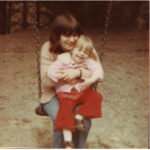
    We pulled out the button (in the UK one would say ‘badge’) machine to amuse the guests, played music, talked, and ate. I proved my claim that the older child is a clone by pulling out pictures of me at the same age; it is in fact rather spooky that she is so like me physically – and nothing like me in terms of personality.

    One of the best parts about making new friends is the fact that they’ve never heard the stories I can’t publish; in the middle of one I remembered the Cautionary Tales series Gabriel and I collaborated on. I pulled it out for the first time in years; my elder child was astonished and kept pestering me to do something with it.

    By the time the last guest rolled out the door at two in the morning it was officially our tenth wedding anniversary.

    We don’t celebrate this milestone as it is such a random marker. I have always viewed marriage as an economic contract (hence the fact that I’ve been married to someone or other continuously for sixteen years).

    In exercising the privilege I have gained access to health insurance, community property protection, inheritance rights, and sundry other novelties that have proved worth the trouble. It is a huge bonus that I really like Byron. We marked the day by drifting around town chatting with friends.

    It was, in short, a brilliant weekend.

  • Lessons in Taxidermy is on the Time Out Chicago Top 10 Books of 2005 list.

  • There are still a few days to survive before the dreaded unbirthday but my nearest and dearest have done their duty, including, from Byron, a subscription to Audible. This is very exciting!

    The first thing I downloaded? Some P.G. Wodehouse, of course.

    I listen to Wodehouse every night as I fall asleep.

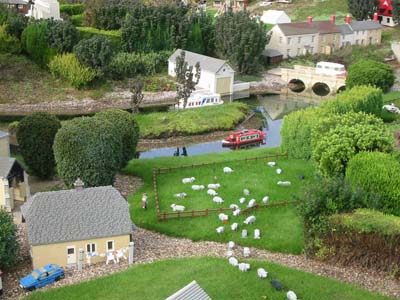
  • For those who wonder what narrowboating looks like (as rendered in Lego):

    Also, life in England (again in Lego):