On his first day of kindergarten we asked our son how it went. He paused, thought for a second, and said “I don’t think you need to know.”
From that moment until quite recently he remained aloof, preferring to conduct his life without reference to parental authority. Now that he is grownup, we are genuinely amazed to be invited to events and excursions.
And the senior show (an opera) was shockingly good. Congratulations to the whole team!
The Portland house is vacant for the first time since we moved away seventeen years ago. All of us have been homesick to some degree since the day we packed up the Volvo and headed off on what would become the start of the big adventure, so I asked each child in turn if they wanted to move back, offering to rent it for the price of the mortgage (quite a bargain since we bought in 1997).
When we left Portland the children were small, feral, and unschooled. For the next decade or so they clamored to go home again, the word home always pointing at that house and that city. But now they’re grown and launched. They have partners and work and lives elsewhere – the family is scattered between NY, London, and Vermont, everyone busy and occupied. The kids declined the offer; they didn’t even have time to come on the trip, to look at the walls they kissed and cried over on the day we moved away.
Through all the years of tenancy there have been friends living there, but we were hesitant to visit – because we didn’t want to intrude, because the city has changed, but more importantly because we missed it. This week Byron and I wandered through the house, then sat in an empty upstairs dormer. Floods of memories came back to both of us: the good times with the children, the hard times as we both worked endless hours.
We owned the house by virtue of my mad planning skills and ability to navigate bureaucracy, and also because it was cheaper than renting. Middle class people did not want to live in the neighborhood in the 1990’s, nobody could even imagine the gentrification that would consume the whole city in the new century. It was a wretched downtrodden sort of place, not the shiny hipster boulevard it has become.
Back then we were poor people, living a shabby impoverished life, without enough money for basic necessities. But (and this is not nostalgia talking, because I’m famously allergic to sentiment) we did have a grand time. There were stories, songs, friends, hope for the future.
I expected the trip to be brief, a quick expedition to decide if we would sell the house. But as we sat there we both wondered: should we go back? Or should we keep moving forward?
The other day I went to dinner with someone who has been a friend for more than twenty years and at some point toward the end of the conversation it became clear that this person has no idea what I do for a living. Or even that I . . . work.
This wouldn’t be surprising in a recent acquaintance; I resist the NYC social imperative to self-promote. Countless dinner parties have involved me waving away questions, refusing to discuss, changing the subject, twisting in all manner of creative ways to avoid recognition of my achievements in any field. I don’t talk about work. Not the writing, and certainly not running companies. Not with people who do understand, not with people who are curious, not any of it, not with anyone.
I know this is unusual, and, well, I don’t care.
But to have a friend who has known me for so long have literally no clue about my occupation is extraordinary. How did this friend imagine I fed and educated myself, clothed and entertained my children, paid for health insurance, bought my house, moved around the world?
I’ve been paying my own way since age sixteen. I had no support from my parents, no public aid, no partner when I became a teen parent. I worked three jobs in college and graduate school, scrabbling for scholarships to make sure I finished without debts. Once I acquired a partner I worked while he went to grad school and launched a career as an academic.
Yes, we share responsibility for family finances, but the emphasis is on the word share. I’ve worked through life-threatening illness, during school field trips, on family excursions to theme parks, through half a dozen funerals. I sat under a reception table and worked during the wedding of dear friends. I worked in the recovery room after my most recent cancer surgery. I sat on hiring committees, ran board meetings, and took my kid to a sci-fi festival in another country while my surgically reconstructed forehead was held together with stitches and tape. Oh yeah, and I never take any drug stronger than coffee.
I work all the time, ceaselessly, and I truly cannot imagine not working. This is my nature, and also my training: it doesn’t matter how much I earn or own. I was born working class and that means I work.
Do I sound a little defensive? I’m certainly sensitive about the subject. But I wasn’t offended, only mystified. And that is the virtue of friendship.
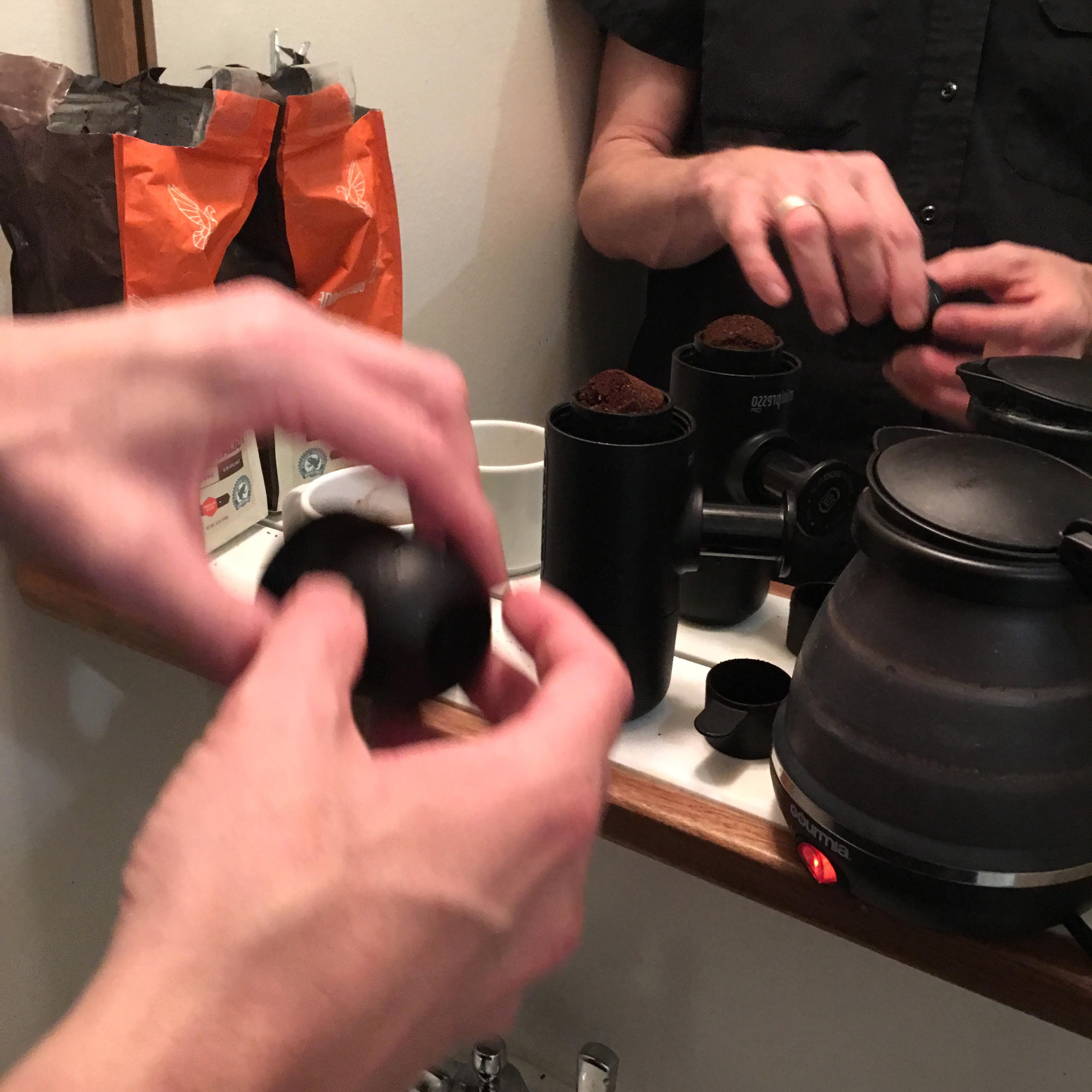
Byron making coffee in a hotel bathroom, somewhere on the west coast.
You might wonder how I manage to travel so much given that I cannot eat in normal human restaurants or houses.
The answer is simple: planning!
I travel with food and the gear to prepare and eat it. My standard kit includes an espresso maker, kettle, cups, colander, plates, utensils, with sufficient basic provisions to eat even if I can’t find a store. And I make it all fit in a standard carry-on.
Along the way I buy vegetables, fruit, and whatever “safe” products exist in each region. Celiac disease is uncommon but distributed evenly across the population, so wherever I go (no matter how urban or rural) there is almost always a store or cafe with certified products.
There can be some anxiety if I don’t speak the language, but packaged foods have standardized labeling in each country. Organizations like Find Me Gluten Free have updated user reviews so it is possible to double check whether a particular venue is being truthful about their offerings. Other people with the disease lead the way, sharing their tips and preferences on blogs and message boards.
The greatest challenge while traveling is the prevalence of products or companies aimed at people who avoid gluten as a lifestyle choice. Why? Because those people do not suffer any ill effect if they are exposed. Gluten is not actually a toxic threat to the larger population, though avoiding it is trendy right now. Every city I visit has beautifully designed, popular establishments with #glutenfree signs in the window. Only a small percentage of these places are safe for me.
People with celiac disease get sick if they are exposed to even tiny crumbs of gluten; some of us get sick at trace levels. The legal standard is expressed as parts per million, which gives some sense of how little it takes to trigger an immune reaction.
I am extremely cautious about establishments that cook without gluten, but do not buy their supplies from certified sources. I am even more suspicious of places that do use safe supplies, but cook in a shared kitchen and serve on the same dishes. Have you ever had to ask for a clean fork, or noticed smears on your water glass? That is above the level of accidental contamination that can put a celiac patient in bed for weeks.
When someone suggests a great new place they know, leads me toward a paleo or vegan or keto cafe because they think it will be perfect, or tells me that a chef can make something special in the back, I shrug. I’ll go along to whatever faddish destination is suggested. I’ll admire the tile on the floor, and ponder how the cement counters were poured, and have a great time hanging out with friends and colleagues. But I won’t eat.
I grew up in a family and community where potluck was the most common type of social gathering, and you certainly never asked what was in the dishes on the table. If you went to see an elderly relative you took a coffee cake; if someone was in need, you delivered a casserole and shared the meal. People were not fussy or inquisitive about ingredients.
In my life in England, the usual place to meet was cheap and cheerful restaurants on Brick Lane, or riverside pubs. Losing the ability to share casual, uncomplicated, random food does feel strange. It also feels discourteous: I was raised to believe that declining food is insulting to the host. There have been many awkward moments when I have to turn down treats baked especially for me by a well-meaning friend, or sit in front of an untouched plate at a wedding dinner. I do it anyway, because the alternative is worse; eating contaminated food is a fast pass to serious illness. But I do miss both my childhood habits, and the convenience of my peripatetic adult life.
There is an unexpected benefit to the disease: it is a great leveler. People with celiac have only one thing in common – a life-threatening immune disorder. Those who persist in traveling after diagnosis have no automatic cultural affiliations. We don’t share political beliefs, sartorial styles, socio-economic backgrounds. We just want to find a sandwich that won’t kill us. I meet the most diverse and interesting people standing in line for gluten free cupcakes.
From Berlin to Bennington, Los Angeles to Lisbon, when celiac people order food we have the same basic question, expressed in many languages but a similar expressive wave of the hand. We ask it everywhere, even in certified gluten free facilities: you’re sure there is no gluten here, right?
Sometimes I find amazing things – a restaurant in Vienna that serves traditional (safe and good) Austrian food. Bakeries in rural Vermont or urban Portland making bread that rivals traditional competitors. Sometimes I find nothing at all, and I sit in my hotel, eating a cucumber and feeling fretful. But I keep traveling.
I’m a pragmatist (and I had cancer as a child) so I skipped a lot of the grief and anger people feel about this disease. Yes, it is annoying, and inconvenient, but it isn’t the end of the road.
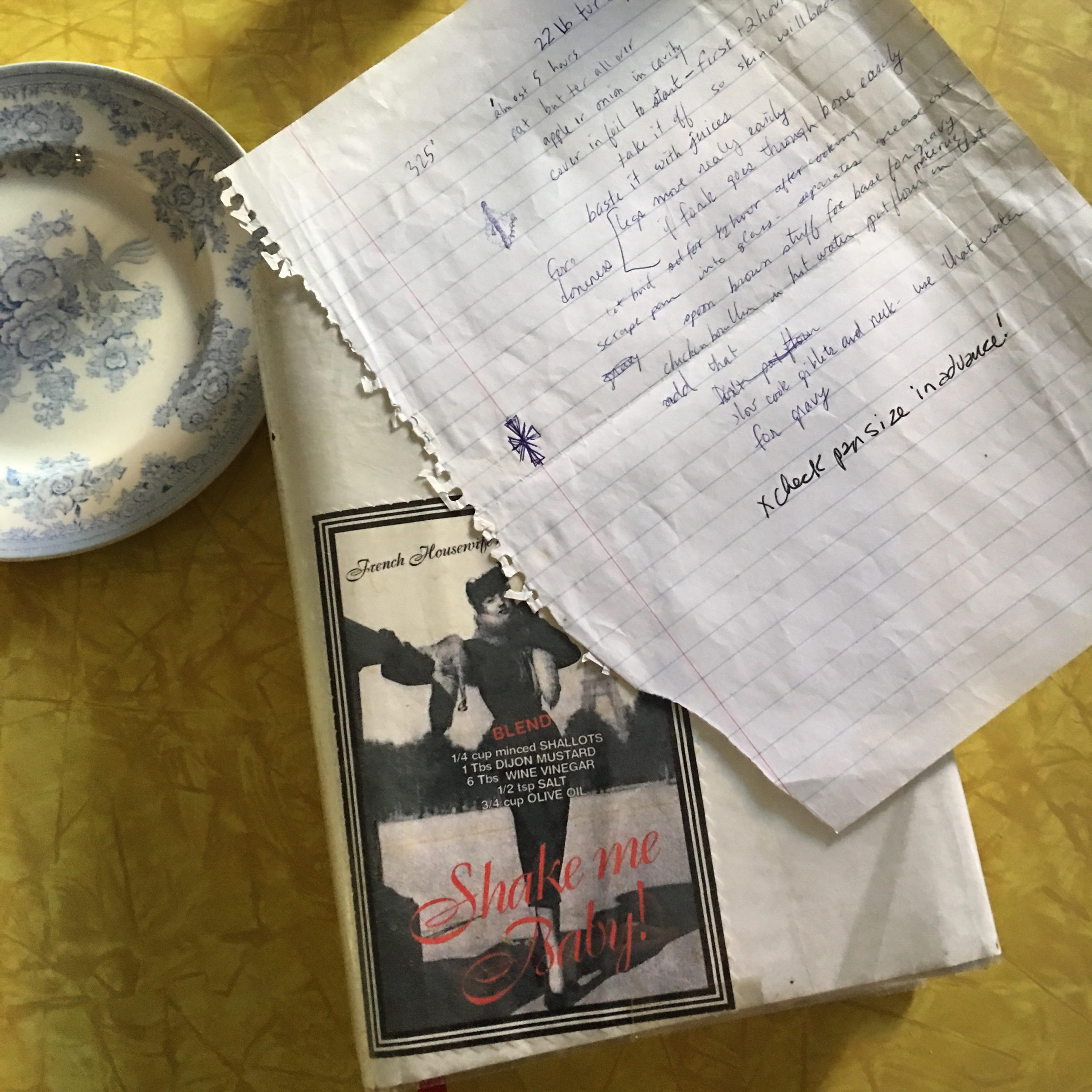
Every year when I start Thanksgiving preparations these are the two key elements: a cookbook Stella gave me at some point in the late 90’s, and a turkey recipe Marisa scribbled down after calling her dad in a moment of culinary crisis in November of 2002.
The book and the recipe have travelled with me from country to country, suffering splatters and hand notations as I converted units of measure and heat. When I started cooking I needed both of them, but over the years I have progressed to the point where they are more like props, or pep talks. I know how to cook a turkey now, but I still consult the directions from Marisa’s dad (RIP). When Stella isn’t here, the book acts as her surrogate, encouraging me to follow my instincts.
My kitchen was built in 1890 and updated no later than 1938. I use old equipment with signs of both love and abuse, much of it from the family homestead in Poulsbo. This year I’m cooking on a table we bought at a thrift store in Tacoma in 1995, when we lived in a shotgun shack with James. I’m serving on plates my Grandma Vi collected with grocery coupons in the 1960’s. When the guests arrive I’ll pull out the pickle dishes Grandma Lavender used, though I’ll probably fill them with olives.
Byron will pour wine for guests in glasses once owned by a beloved friend he knew growing up in a church in Denver in the 1970’s. When Ann died we inherited her wine glasses and a set of blue glass dessert plates, now in regular rotation in my dining room. They are stored in a Jackson Press, a family heirloom from Tennessee, in a room filled with photographs of my dead grandmothers.
Everything in this house holds a memory, and touching each item brings back lost time — and lost people.